About Megalops cyprinoides (Broussonet, 1782)
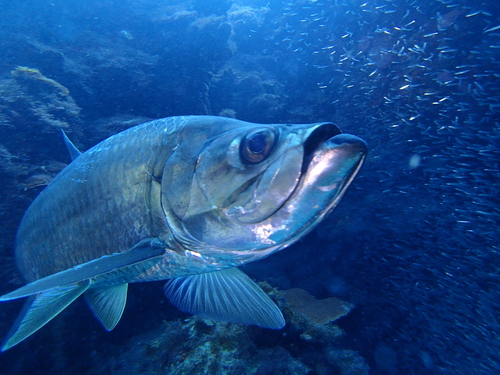
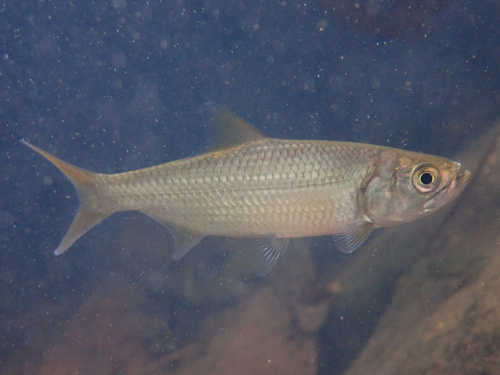
This species, Megalops cyprinoides, is similar in appearance to the much larger related species Atlantic tarpon M. atlanticus. It has an olive-green dorsal coloration and silver sides. Its large mouth is upturned, and the lower jaw holds an elongated, bony plate. The last ray of its dorsal fin is much longer than the other rays, reaching almost to the tail. Megalops cyprinoides can fill its swim bladder with air and absorb oxygen from this air. Freshwater-dwelling individuals are typically smaller than saltwater individuals: freshwater fish grow to just over 50 cm (20 in), while saltwater individuals grow over 1 m (3.3 ft). Individuals can live up to 44 years, reach maturity within two years, and complete metamorphosis from the larval stage in 10 days. This species, commonly called the Indo-Pacific tarpon, is distributed from the coasts of East Africa and the Arabian Peninsula to the coastal waters of South Asia, Southeast Asia, southern Japan, French Polynesia, and southern Australia. Its typical habitats include coastal waters, estuaries, and freshwater rivers and lakes located many miles upstream from estuaries. It is amphidromous, meaning it migrates between rivers and the sea. It occurs across many tropical areas of Australia, in tropical, coastal, and brackish waters of the Indo-Pacific Ocean, and can live in both fresh and salt water. It is widely distributed across Australia, Japan, South Asia, Southeast Asia, and East Africa. Current population data for Megalops cyprinoides is deficient, as details of commercial landings and human disturbances to the species remain unknown. However, it is confirmed to be extremely common across its entire range, and over 300 specimens are held in museum collections.