About Megalops atlanticus Valenciennes, 1847
Atlantic tarpon (Megalops atlanticus Valenciennes, 1847) evolved approximately 18 million years ago, making them one of the oldest living fish species. Recorded maximum measurements for this species reach 2.5 m (8 ft 2 in) in length and 161 kg (355 lb) in total weight, and males rarely weigh more than 100 pounds. Similar to a primitive lung, Atlantic tarpon can fill their swim bladder with air. This adaptation gives them a predatory advantage when oxygen levels in the water are low.
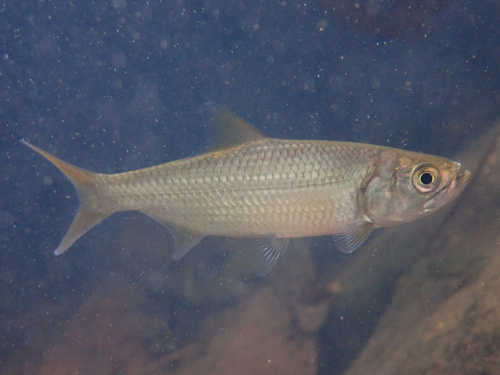
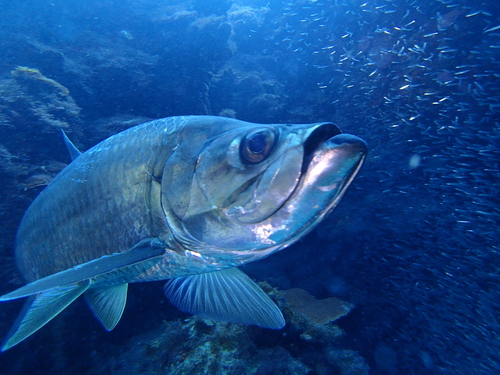
In terms of appearance, Atlantic tarpon are greenish or bluish along their upper body, and silver on their sides. They have a large upward-turned mouth, and the lower jaw holds an elongated, bony plate. The last ray of the dorsal fin is much longer than the other dorsal fin rays, extending nearly to the tail.
Because Atlantic tarpon are not commercially valuable as food fish, very little documentation exists about their full geographical distribution and migratory patterns. They inhabit both sides of the Atlantic Ocean. In the eastern Atlantic, their range is reliably confirmed to extend from Senegal to the Congo. In the western Atlantic, they are principally found in warmer coastal waters, primarily around the Gulf of Mexico, Florida, and the West Indies. Even so, anglers regularly catch Atlantic tarpon at Cape Hatteras, and as far north as Nova Scotia and Bermuda, and as far south as Argentina. In the Gulf of Mexico, there are two distinct populations separated by the Mississippi River Delta.
Atlantic tarpon are highly migratory and often cross international boundaries, which creates challenges for their management and conservation. Scientific studies show that schools of Atlantic tarpon have routinely migrated through the Panama Canal from the Atlantic to the Pacific and back again for over 80 years. Because Atlantic tarpon tolerate a wide range of salinity and are opportunistic feeders, their migrations are only limited by water temperature. They prefer water temperatures between 22 to 28 °C (72 to 82 °F). Below 16 °C (61 °F), they become inactive, and temperatures under 4 °C (39 °F) can be lethal. A large Atlantic tarpon community lives in the Rio San Juan and Lake Nicaragua. A permanent population has become established in Costa Rica in the Pacific Ocean, and the species was recorded in northern Peru in 2024.
Atlantic tarpon breed in spawning aggregations in the open ocean. They share a unique larval stage called a leptocephalus with bonefish, ladyfish, and eels. Unlike the larvae of most other fish, these leptocephali do not feed, because their long, slender bodies have very low energy requirements. While in the larval stage, Atlantic tarpon teeth grow pointed forward to keep debris out of their mouth. Leptocephali develop into juveniles that move inshore, often into stagnant water with very low oxygen content that cannot be tolerated by most of the tarpon's predators. When they are about three years old, Atlantic tarpon migrate from these backwater habitats to a range of nearshore habitats, where they grow rapidly, primarily gaining length rather than girth. At around eight years of age, Atlantic tarpon reach sexual maturity, and begin gaining both length and girth. At this point, growth rates diverge, with males growing much slower than females. Sexually mature Atlantic tarpon then begin migrating to join spawning aggregations.