About Megalobulimus dryades Fontenelle, Simone & Cavallari, 2021
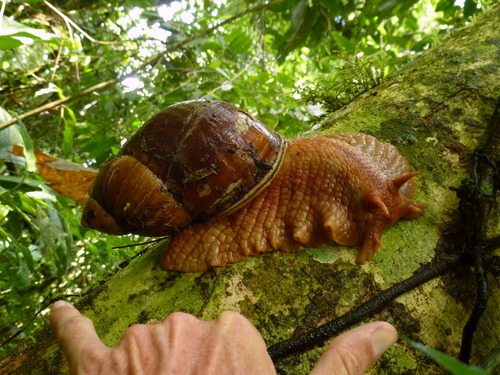
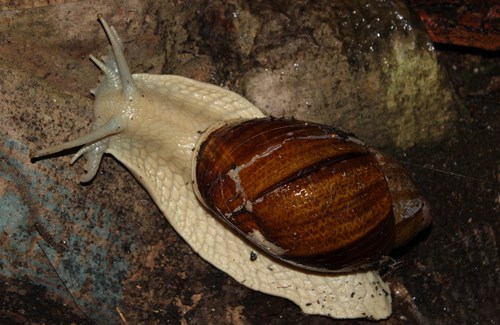
Megalobulimus dryades is a species of air-breathing land snail, a terrestrial gastropod mollusc in the family Strophocheilidae. It was officially described in 2021 by Fontenelle, Simone & Cavallari. Before its formal description, this species was misidentified as Megalobulimus gummatus. It was recognized as a distinct species due to its unique morphological and anatomical traits, particularly in its shell and reproductive system. This species is endemic to the Atlantic Forest of Brazil, specifically in the southeastern region that includes parts of São Paulo and Paraná states. Its primary habitat is the middle and lower Ribeira de Iguape River basin, located in southern São Paulo state and northeastern Paraná state within the Atlantic Forest biome. The species has also been recorded in western Santa Catarina state, where these records were previously misidentified as M. gummatus. It is known to live in protected areas including Alto Ribeira Tourist State Park and Intervales State Park. M. dryades has high environmental tolerance, which may have allowed it to spread more broadly; its use in local handicrafts may also have contributed to anthropogenic dispersion, meaning the species could have a wider range than currently documented. The shell of M. dryades is ovate-conical and robust, growing up to 120 mm in length. It has a reddish-ochre coloring, with a characteristic pale subsutural band and a darker protoconch. Anatomically, the species is distinguished by a long convoluted penis with two flagella, as well as unique radular and jaw structures. Studies of its reproductive behavior in captivity, conducted in 2002 when the species was still classified as M. gummatus, used specimens from the Vale do Ribeira region. These studies found that oviposition (egg-laying) is seasonal, occurring in two distinct periods: a longer season from April to May, and a shorter season between September and November. Females produce clutches of 2 to 5 eggs per clutch. The eggs are relatively large, averaging around 28.6 mm in length and 21.3 mm in width. After an incubation period of approximately 60 days, the average hatching success rate is around 52%. M. dryades has not yet been assessed by the IUCN Red List. However, the highly threatened Atlantic Forest biome faces widespread habitat loss and forest fragmentation, and declines have already been reported for southern populations of this species, so M. dryades is likely under threat from these and other pressing threats to its habitat. Local people use the shells of this species for handicrafts.