About Megaderus stigma (Linnaeus, 1758)
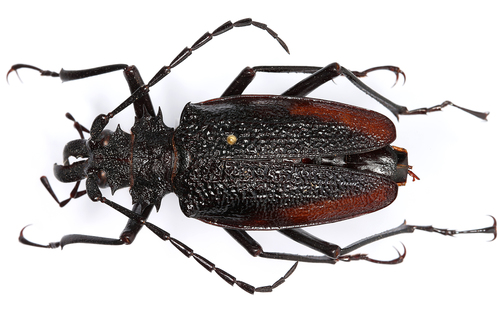
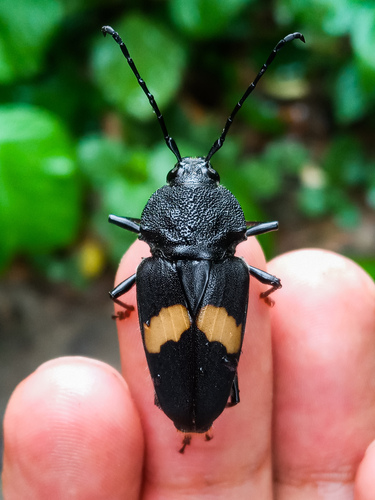
Megaderus stigma is a species of long-horned beetle that belongs to the family Cerambycidae. Its known distribution includes Nicaragua, Costa Rica, Panama, Trinidad & Tobago, Colombia, Venezuela, Guyana, Suriname, French Guiana, Brazil (the states of Paraíba, Pernambuco, Alagoas, Bahia, Mato Grosso, Minas Gerais, Espírito Santo, Rio de Janeiro, São Paulo, Paraná, Santa Catarina, and Rio Grande do Sul), Peru, Bolivia, Paraguay, Argentina, and Uruguay. This species was first described by Carl Linnaeus in 1758, originally under the name Cerambyx. Linnaeus's original description characterizes it as follows: a relatively short, roundish Cerambyx with coarse punctation, a dark body, and smooth elytra marked with a white spot. It was recorded to occur in America, based on material collected by Rolander. The species is entirely black; its thorax is hemispherical, has a faint margin, is densely covered in coarse punctation, and has a posterior excavation close to the lateral tooth. The scutellum is smooth and longer than the scutellum of other related species. The elytra are smooth and black, with an outward-angled oblique white line on each side adjacent to the scutellum.