About Megaderma spasma (Linnaeus, 1758)
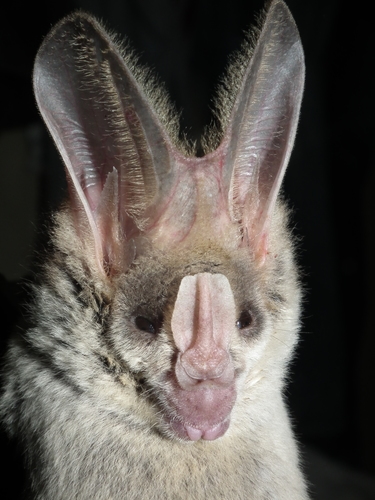
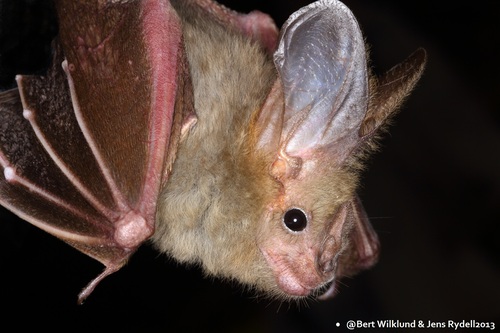
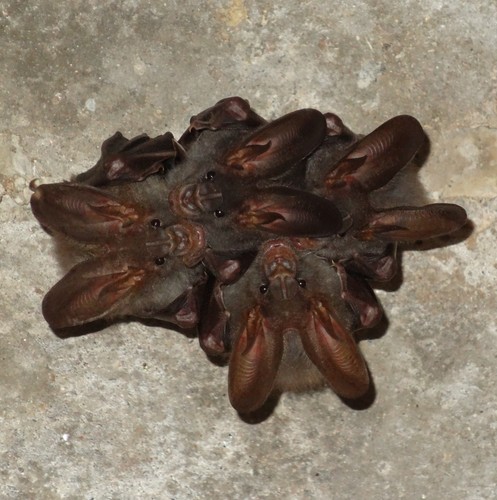
Megaderma spasma (Linnaeus, 1758), commonly known as the lesser false vampire bat, has a maximum wingspan of 30 centimetres (12 in), an average head-and-body length of around 10 centimetres (3.9 in), and forearms that typically measure around 7 centimetres (2.8 in). Yellowish veins run through this bat’s wings; when wings are spread with light behind them, they show a prominent yellow or orange tinge. Body fur color ranges from pale grey, to grey-brown, blue-brown, and this species has no visible tail. The noseleaf has a long dorsal lobe with a stiffened central ridge, plus broad convex flaps along the sides. Its ears are very large and joined at the base. This species has well-developed, forward-pointing eyes that allow it to locate prey visually. Its echolocation pulses are short, low in density, and broadband; its large ears are sensitive both to echoes from these pulses and to sounds generated by the bat’s prey. Lesser false vampire bats roost in rock crevices, caves, foliage, and hollow trees depending on availability, and they also rest hanging on trees in general. They typically roost in groups of 3 to 30 individuals, and may also roost in pits and human-built structures. Their diet favors grasshoppers and moths, but they sometimes eat small vertebrates, including other bats. This species is classified in the order Chiroptera, family Megadermatidae. This family contains four genera and five total species. Megaderma spasma is the sister species to the greater false vampire bat, which is the only other species in the genus Megaderma. The species’ type locality is Ternate, in the Maluku Islands of Indonesia. Two specimens collected from Niah and Batu 16, Ulu Gombak are held at the Sarawak Museum Unimas. The distribution of M. spasma covers the southern and eastern Indian Subcontinent, including India, Bangladesh, Bhutan, Sri Lanka, and the Andaman and Nicobar Islands. It is also found across mainland Southeast Asia, the Malay Peninsula, the Philippines, and most of Indonesia. For humans, the ecological impact of this species can be both positive and negative. It consumes insects that damage human crops, but it may also carry and transmit certain diseases.