About Megacrania batesii Kirby, 1896
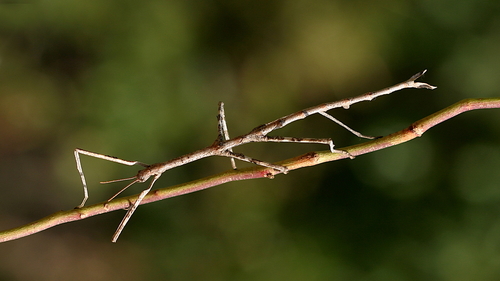
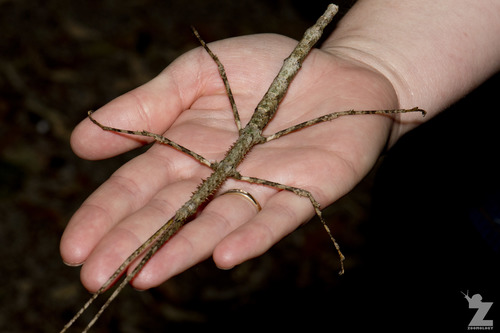
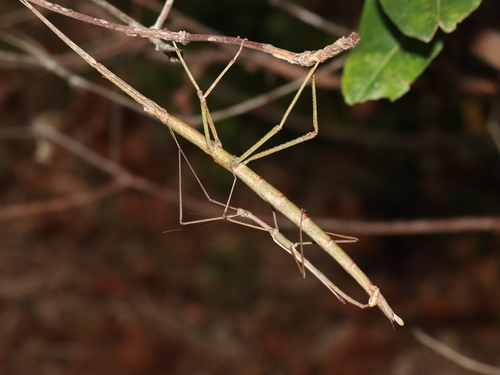
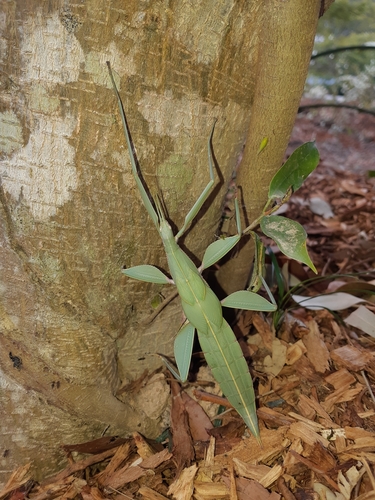
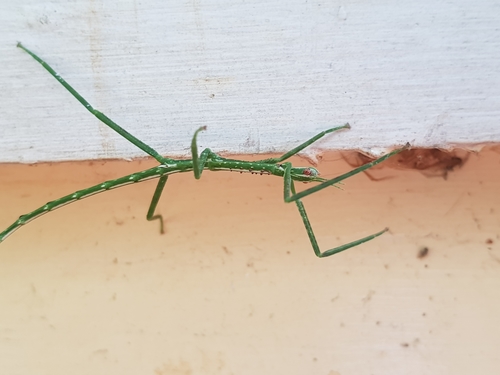
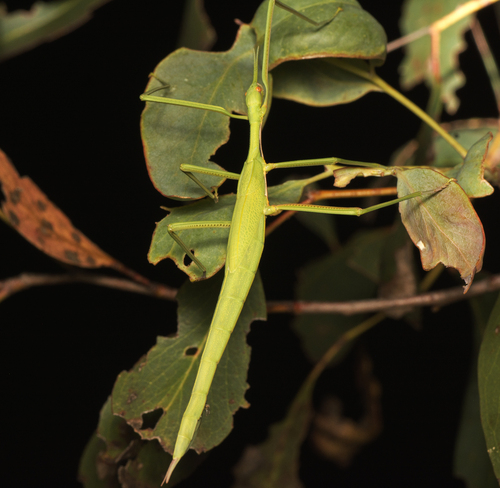
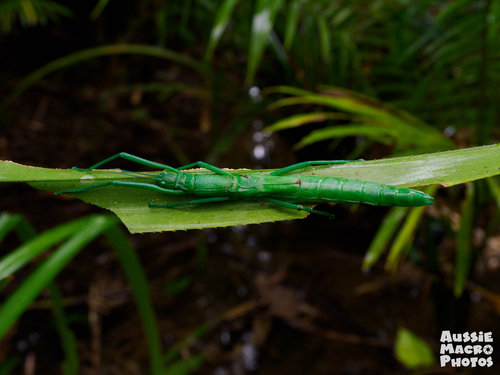
Like most phasmid species, Megacrania batesii males are considerably smaller than females. Male body length ranges from 76 to 87 millimeters (3.0 to 3.4 in), while female body length ranges from 98 to 137 millimeters (3.9 to 5.4 in). Males also have smaller prothoraxes and mesothoraxes than females. Tegmina are roughly the same size in both sexes, but male hind wings are larger relative to body size. For adults and last larval instars, the entire body is mostly uniformly pale green, with the head, thorax, mesothorax and legs slightly darker than the tegmina. Antennae, wing-buds and eyes may sometimes be colored yellow, red, or black. This species has a restricted, patchy distribution across the Solomon Islands, New Guinea, and possibly the Philippines. It also has two distinct Australian populations: one on Queensland’s Cape York Peninsula, and the other on the Sir Edward Pellew Group of Islands in the Gulf of Carpentaria. Its primary habitat is complex mesophyll vine forest, most often at the transition zone between rainforest and beach, where it lives on pandanus plants. Rarely, it has been recorded next to rainforest streams or swamps up to 5 km inland. Because the species occupies a total area of less than 100 km² in a highly fragmented distribution, it meets IUCN criteria for classification as a vulnerable species. Isolated subpopulations in northern Queensland face risk of local extinction from both natural and human-caused hazards. These are sedentary insects that usually rest on the upper surfaces of leaves of Pandanaceae species, which they feed on. When resting, they hold their front and mid legs stretched far forward, and their hind legs stretched to the rear. They do not appear to use their hind legs for locomotion. Although both sexes have wings, Megacrania batesii cannot fly. Males, which have proportionally larger hind wings relative to their body size, can parachute to the forest floor when threatened. The species is not gregarious; rarely do more than 3 individuals live on a single leaf cluster. The vast majority of wild observed and collected specimens are female, and male individuals are uncommon. Parthenogenesis is the primary mode of reproduction for some populations of Megacrania batesii, though sexual reproduction has been recorded in other populations, including in captive settings.