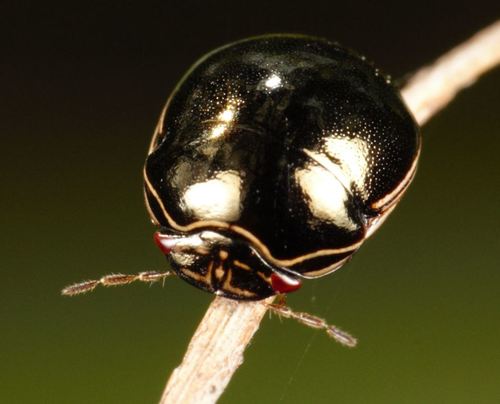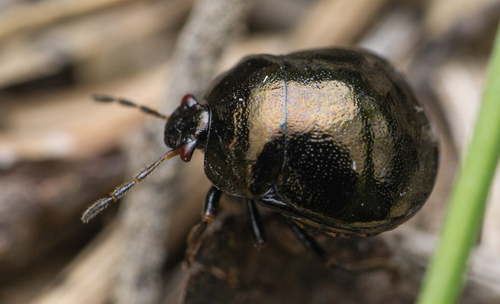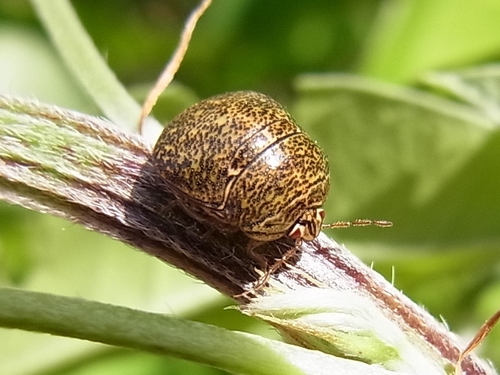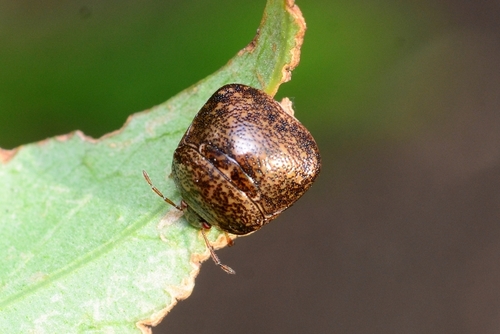
About Megacopta cribraria (Fabricius, 1798)
Megacopta cribraria, commonly known as the bean plataspid, kudzu bug, globular stink bug, and lablab bug, is a species of shield bug native to India and China. In its native range, it acts as an agricultural pest that targets lablab beans and other legumes. Though this bug is harmless to people and houseplants, it frequently enters human homes. It is attracted to highly reflective white surfaces, like house walls or white vehicles, due to how these surfaces interact with its simple eyes. As a defensive adaptation, the bug releases a foul-smelling pheromone that also functions as a congregation pheromone. In addition to its unpleasant odor, the pheromone liquid can cause a burning sensation and sometimes leaves a red welt on bare skin. Like other members of the family Plataspidae, Megacopta cribraria has an unusual symbiotic relationship with bacteria living in its gut. Before laying eggs, females deposit particles that contain the symbiotic bacteria; newly hatched nymphs eat these particles under natural conditions. Experiments have shown that nymphs deprived of access to the symbiont grow more slowly, reach smaller adult body sizes, and experience higher mortality. Japanese populations of M. cribraria were previously classified as the separate species Megacopta punctatissima, also called the Japanese common stink bug, which carries a gut symbiont that lets it feed on crops such as soybean. The two were long treated as distinct species, but phylogenetic research has confirmed they are not separate species. The population of M. cribraria invasive in the United States is most likely descended from the former "M. punctatissima" population from Kyushu, Japan. The Japanese population is genetically closest to the East Asian continental population. These two populations diverged 0.71 million years ago, when the East China Sea land bridge became submerged. The East Asian continental population split from the Southeast Asian population 1.34 million years ago. The bean plataspid releases an offensive odor when touched, squashed, or prodded. It is hosted by wisteria, green beans, and other legumes, and feeds by sucking sap from the stems of soybean plants, which reduces crop yield. However, when it infests kudzu (an invasive plant species), it significantly reduces kudzu growth. In 2011, within the bug's invasive range in Georgia, adult M. cribraria had an extremely high aggregation slope when measured using Taylor's Power Law, with a value of 3.27 ± 0.115, and the slope values followed the order b_adults > b_nymphs > b_eggs. By the following year, and continuing at least through 2013, the adult aggregation slope was much lower, and the order of slope values reversed to b_eggs > b_nymphs > b_adults.