About Megachile pugnata Say, 1837
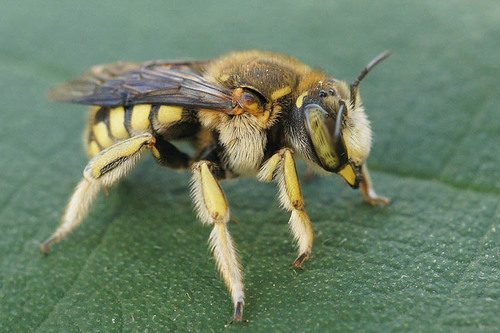
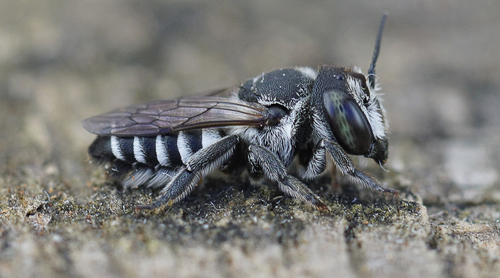
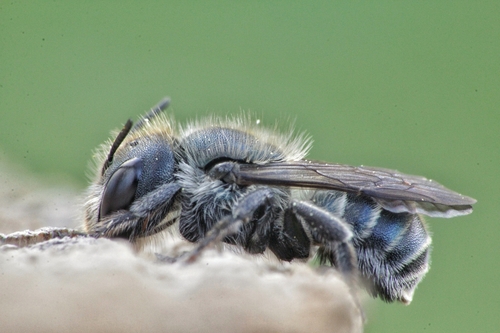
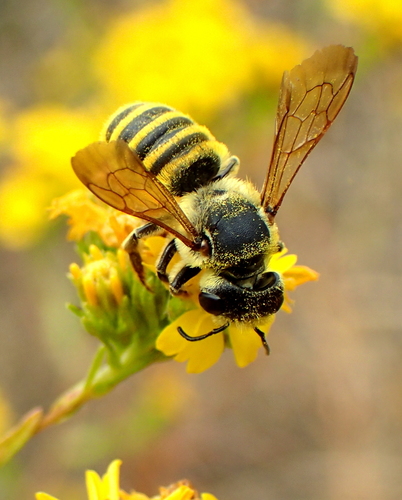
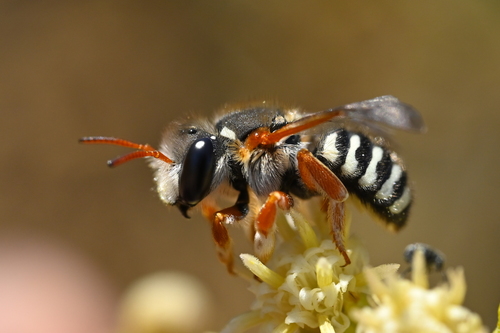
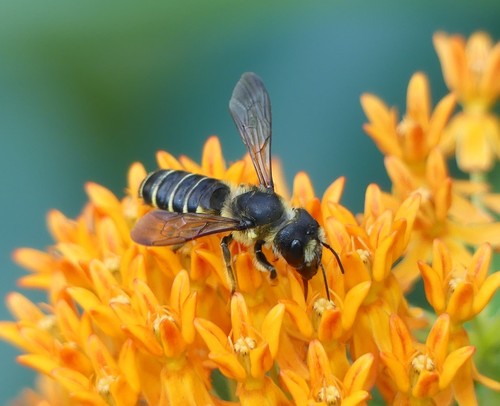
Megachile pugnata is a species of North American bee in the family Megachilidae, first described by Thomas Say in 1837. It is a larger species of Megachile: the body length of a typical female ranges from 12 to 18 mm, while the body length of a male ranges from 11 to 13 mm. The outer carapace of both males and females is entirely black. Females also have black eyes, while males have lighter grey or green eyes. The ventral side of female abdomens features rows of densely packed hairs, which help collect pollen. Males have much less densely packed rings of hairs between each abdominal segment. Both sexes have large mandibles, which are particularly important for females, who use their mandibles to slice through leaves to build their nests. Females have a pointed tip at the end of the abdomen, while males have a club-like, rounded abdominal terminus. All of the female’s limbs are covered in hairs, while the male’s forelimbs are heavily modified to have a dense brush of bright yellow hair. This species is found only in North America, in Canada and the United States. In Canada, its range extends east to west from Prince Edward Island to British Columbia, and north to south from the country’s southern border to the Northwest Territories and Yukon. In the United States, its native range reaches as far south as Georgia and as far west as southern California. It has not been observed in parts of the Great Plains, the Great Basin, and the Gulf Coast. M. pugnata is an excellent pollinator for sunflowers. They forage early in the day, when male sunflowers release pollen, which means large amounts of pollen are available for the bees to carry, resulting in ample pollination for female sunflowers. However, there are challenges to using these bees in agriculture. Unlike other species in the same genus, such as the commercially used Megachile rotundata, M. pugnata does not produce individually leaf-wrapped brood cells; instead, cells are separated by plugs. This means the cells cannot be easily separated for agricultural management. This separation difficulty increases the risk of significant parasite and fungal infections for these bees, because newly emerged adult bees often must chew through dead larvae to exit their cells. M. pugnata has multiple known parasites: it is parasitized by species of melittobia and monodontomerus wasps, as well as the cuckoo bee Coelioxys alternata. Dead larvae can carry fungal spores or parasitoid larvae, which can then infect the emerging bee as it chews through the dead material to exit.