About Megachile nigrovittata Cockerell, 1906
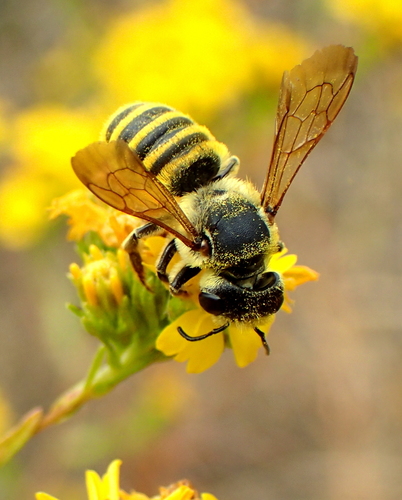
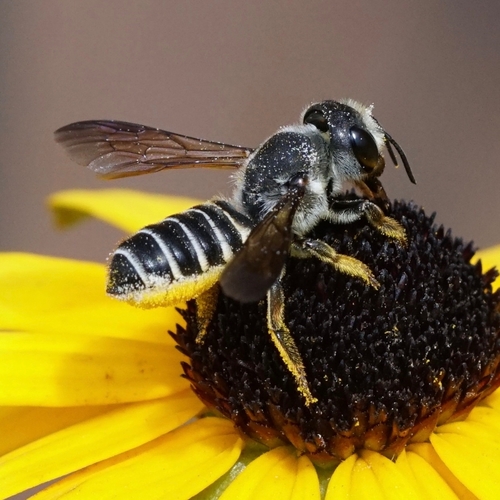
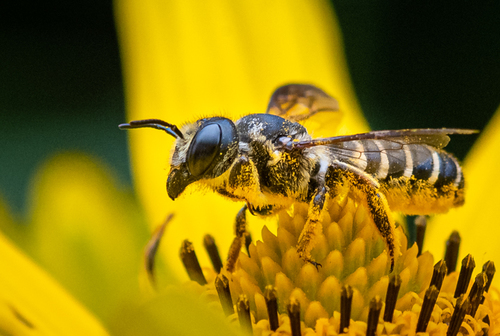
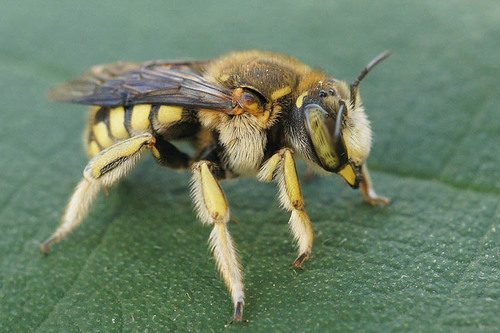
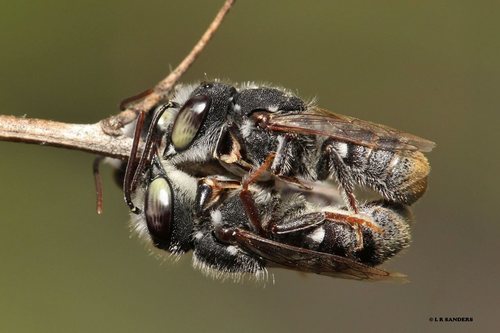
Male Megachile nigrovittata measure slightly over 8 mm in length. Their last three abdominal segments are covered in short, orange hair. Middle legs are dark reddish, with a small light patch on the tibia, a white spur, and a bend in the basal joint of the tarsus. The labrum is long, with rounded corners at its front edge. The face is covered in yellowish-white hair, and the eyes are light yellowish-green. The underside of the antennae is brown. Wings are transparent, and the stigma, the thickened spot on the front margin of the forewing, is pale with a dark margin. A row of pits runs across the base of the propodeum. Like males of many other species in the genus Megachile, male M. nigrovittata have elaborately modified front legs. The front tibiae are black and shiny, with a white patch at the end. The front tarsi are white and expanded; the first three joints form a large oblong structure. This structure is concave on the underside, and on the upper side it bears a long black streak with two branches extending from its front. A dark red-brown band runs around the hind margin of the first tarsal joint. In the center of the oblong structure are two oblong black spots, which appear as blue shading on the upper surface. The fourth and fifth tarsal joints are much smaller, but are also broadened. The fifth joint has a lateral projection, and the claws are white. Megachile nigrovittata has been recorded in New South Wales, Northern Territory, Queensland, South Australia and Western Australia. This species has been recorded visiting the flowers of Eucalyptus, Acacia and Atalaya hemiglauca. Females carry pollen using specialized hairs on the underside of the abdomen, and the species is solitary. Females construct nests in existing cavities, including man-made bee hotels. In each brood cell, the female deposits an egg along with larval food provisions, then seals the nest with resin collected from nearby vegetation.