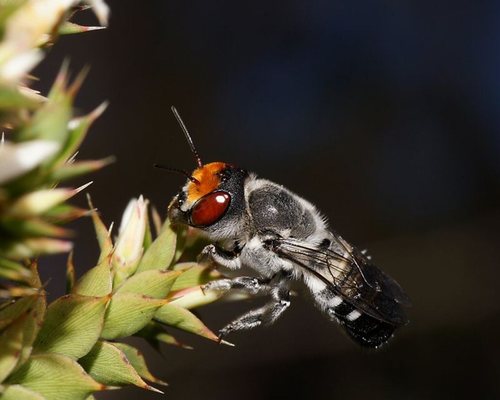
About Megachile aurifrons Smith, 1853
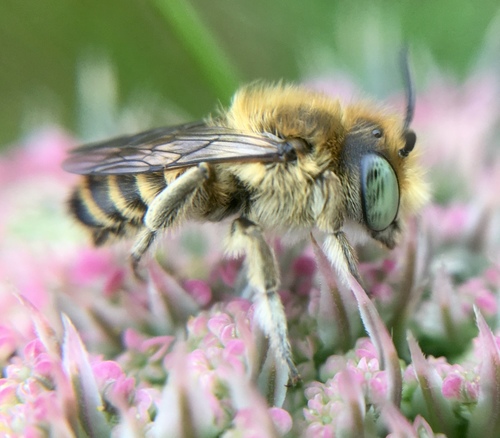
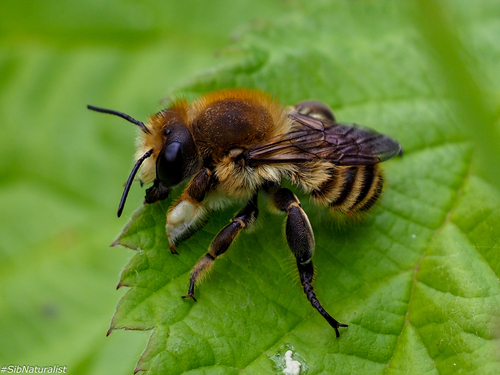
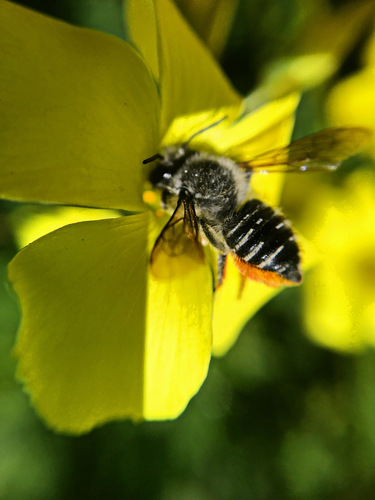
Megachile aurifrons, commonly known as the red-eyed bee or golden-browed resin bee, is a species of solitary bee in the family Megachilidae. It was first formally described in 1853 by Frederick Smith, and is found across mainland Australia. Females of this species measure approximately 12 millimetres in length, with bright red eyes and orange facial hair. Males are approximately 10 millimetres in length, with bicoloured eyes, mostly white facial hair, and modified front legs. This species builds its nests in a variety of natural and man-made cavities, and has been recorded visiting flowers from a wide range of plant families. Megachile aurifrons occurs throughout mainland Australia, and can be found in both arid and urban areas. Natural nesting cavities for this species include holes created by wood-boring beetles, large gum nuts, and vacated nests of mud wasps from the genera Abispa, Delta, Eumenes and Sceliphron. It also nests in man-made cavities, such as bee hotels, plastic piping, screw holes in outdoor furniture, and holes in fence posts, mortar or sandstone. The species prefers nesting cavities with a diameter between 6 and 10 millimetres. Unlike most other species in the genus Megachile, Megachile aurifrons does not build individual cells inside its nest. Instead, it creates a communal mass of pollen for provisioning, and deposits its eggs in separate cavities within this mass. When provisioning the nest, females enter the cavity head first, then back out and re-enter tail-first to scrape pollen into the nest. The completed nest is sealed using resin and masticated leaf tissue; it may also be finished with other materials such as wood dust or fibres from old flowers. As larvae develop, they may compete for the remaining food, which may explain the observed size variation among adult individuals of the species. When fully fed, the larvae spin firm, brown cocoons in a cluster, before developing into pupae and then adult bees. Under ideal conditions, a new generation of adults emerges two to three months after the nest is sealed. Warmer temperatures can shorten this development time, while cooler temperatures can lengthen it. If eggs are laid late in the season, the offspring will enter diapause until warmer conditions return. This species has been recorded visiting flowers from a wide range of plant families, including Myrtacea, Fabaceae, Goodeniaceae, Loranthaceae, Papilionaceae, Polygalaceae and Proteacea. Adult Megachile aurifrons can be seen year-round in northern Australia, and only from spring to late summer in cooler regions. Males of the species have been observed carrying nymphs of the parasitic mite Chaetodactylus. Females can sting if handled, but are not aggressive.