About Megaceryle torquata (Linnaeus, 1766)
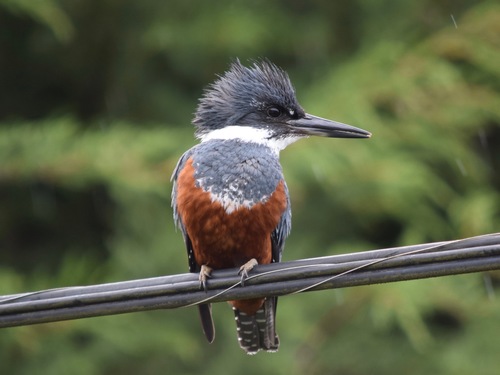
Megaceryle torquata, commonly called the ringed kingfisher, is a Neotropical kingfisher whose range extends from the United States down through Mexico to South America. The species was first recorded in the US in 1888, and the first ringed kingfisher nest found in the US was documented in 1970. Today, they are commonly seen along the Rio Grande and around water bodies in southern Texas, and their distribution is increasing and expanding northward. All age groups of ringed kingfishers have consistent dark-brown irises. They have straight bills longer than their heads, with curved culmens and tomial serrations; the lower mandible has yellowish coloring. Their feet are syndactyl, with olive-green or yellowish toes and black claws. A large crest sits between the base of the bill and the neck, and many individuals have a white collar around the neck. Ringed kingfishers occur in freshwater habitats, tropical and temperate marine shorelines, and islands such as Coiba Island. They breed in aquatic areas with populations of fish, which support the species when they dig nesting burrows, though nests can sometimes be found further from water. All their habitats are located near water bodies including streams, rivers, ponds, lakes, estuaries, and marine habitats. They prefer habitats with clear water and sparse vegetation, which lets them access prey more easily. The breeding ranges of ringed kingfishers span the Neotropics, including Mexico, the Caribbean, and South America, and they have been observed preferring mangrove habitats in the tropics. The ranges of ringed kingfishers and belted kingfishers overlap across Central America and regions further north for 6 to 8 months each year, and ringed kingfisher ranges also overlap with those of other kingfisher species in Central and South America. Ringed kingfishers can forage offshore as far as 1 kilometer (0.7 miles). Overwintering ringed kingfishers do not stay tied to breeding ranges, and can forage over larger areas than they do during the breeding season. Large irrigation canals along the Rio Grande in Texas are used as wintering grounds by this species. During the dry season, they are typically found in areas with high fish densities.