About Megaceryle lugubris (Temminck, 1834)
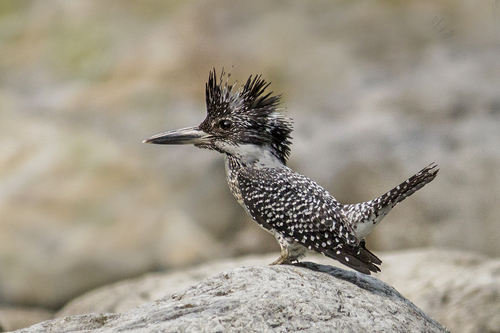
The crested kingfisher, scientifically named Megaceryle lugubris (Temminck, 1834), is a very large, stocky black and white bird. Adults typically measure 38 to 43 cm (15 to 17 in) in length and weigh 230 to 280 g (8 to 10 oz). It has a large, pointed black bill with a yellowish-white tip, and a large, shaggy black and white barred crest. Its upperparts have fine black and white barring, its flanks have grey and white barring, its belly is white, and it has a black-speckled breastband. A white collar runs from the base of the bill around to the back of its neck. Its tail feathers are black with 6 to 8 white bars. Males and females are the same size, but have different plumage as part of sexual dimorphism. Females have bright pink-cinnamon underwing coverts tinged with pale rufous, while males do not have this marking, and instead have rufous-orange feathers on their breastband.
Among all Cerylinae kingfishers, the crested kingfisher has the most restricted distribution. Its range extends from northeast Afghanistan through central Vietnam to Japan. The four recognized subspecies each have separate distribution ranges: M. l. continentalis is found in the western-central Himalayas, from Afghanistan to Bhutan; M. l. guttulata ranges from the eastern Himalayas to central China and northern Indochina, from Bhutan to Vietnam, China and North Korea; M. l. pallida is located in Hokkaido (northern Japan) and the southern Kuril Islands (Russia); and M. l. lugubris occurs in central and southern Japan, on Honshu, Shikoku and Kyushu. Populations that live at higher elevations in the Himalayas and Japan make altitudinal migrations in winter to avoid frozen rivers. In Hokkaido, the birds stay around hot springs through winter, while crested kingfisher populations elsewhere are generally sedentary.
Crested kingfishers inhabit forested areas near rivers and mountain foothills. Where their range overlaps with the common kingfisher, crested kingfishers occur at higher altitudes than common kingfishers. Nest sites are usually located in forest near streams or ravines, but can be as far as 1.5 km from water. Nests are burrows dug into vertical sandy banks that are at least 2 m high. For reproduction, both the male and female crested kingfisher work together to excavate the burrow nest using their bills and feet. The burrow is 10–15 cm (3.9–5.9 in) wide, 2–3 m (6 ft 7 in – 9 ft 10 in) long, and typically ends in an unlined chamber 30–50 cm (12–20 in) across. Observations of a breeding population in Hokkaido found that nests are dug below the upper edge of river banks made of loose volcanic ash, and that if diggers encounter a hard object while excavating, they will dig a new burrow instead of going around the obstacle. Clutches hold 4 to 7 eggs, laid between March and July depending on the subspecies. Only the female incubates the eggs. Both parents feed the nestlings for approximately 40 days before the young birds fledge.