About Megaceryle alcyon (Linnaeus, 1758)
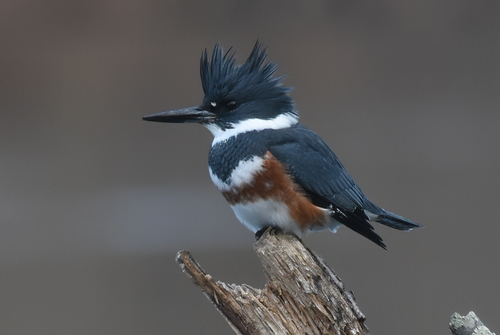
The belted kingfisher (Megaceryle alcyon) is a stocky, medium-sized bird. It measures 28–35 cm (11–14 in) in length, has a wingspan of 48–58 cm (19–23 in), and weighs between 113 and 178 g (4.0 to 6.3 oz). Adult females average slightly larger than adult males. This species has a large head with a shaggy crest, and a long, heavy bill that is black with a grey base — traits shared by many kingfisher species. Both adult sexes have a slate blue head, a large white collar, a large blue breast band, and white underparts. Their back and wings are slate blue, with black feather tips that have small white dots. Adult females have an additional rufous band that crosses the upper belly and extends down the flanks. Juvenile belted kingfishers resemble adults, but both juvenile sexes have a rufous band on the upper belly. Juvenile males have a somewhat mottled rufous band, while the band on juvenile females is much thinner than that of adult females. Across most of its range, the belted kingfisher is the only kingfisher present. Its breeding habitat is located near inland bodies of water or coasts across most of North America, including Canada, Alaska, and the United States. Birds from the northern parts of the species' range migrate to the southern United States, Mexico, Central America, and the West Indies for winter; it is a permanent resident in warmer parts of the range, and a small number of individuals may stay in northern areas outside the Arctic through winter if open water remains available. It is a rare visitor to northern Colombia, northern Venezuela, and the Guianas. During migration, it may stray far from land, and has been recorded as an accidental visitor to several Pacific islands including Cocos Island, Malpelo Island, Hawaii, and Clarion Island, as well as the Azores. It is an extremely rare vagrant in Ecuador, Greenland, Ireland, the Netherlands, Portugal, and the United Kingdom; the United Kingdom has five recorded occurrences of the species since 1908. The southernmost records of this species are from the Galapagos Archipelago, insular Ecuador, where it occurs as a migrant in small numbers and does not appear to visit every year. Belted kingfishers are often seen perched prominently on trees, posts, or other suitable watchpoints close to water, before plunging headfirst into the water to catch fish prey. They also eat amphibians, molluscs, small crustaceans, insects, small mammals, small birds, reptiles, and berries. They have been observed pounding their prey against their perch or the ground to stun and kill it before eating. When flying through their habitat, they frequently give a characteristic rattling call. A small group of belted kingfishers is called a rattle, concentration, or kerfuffle. These birds nest in horizontal tunnels excavated by both parents into river banks or sand banks. Their burrow-like nests are 3 to 6 feet (0.914 to 1.829 meters) deep. Nests are often sloped uphill; one proposed explanation for this slope is that an elevated end creates an air pocket that allows chicks to survive if the tunnel floods. Females lay 5 to 8 eggs, and both adults share incubation and chick-feeding duties. During the breeding season, males are strongly territorial in the immediate area around their nest, and will chase away other members of the species as well as predators.