About Megabalanus coccopoma (Darwin, 1854)
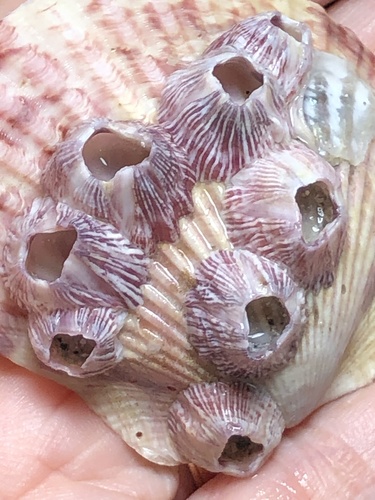
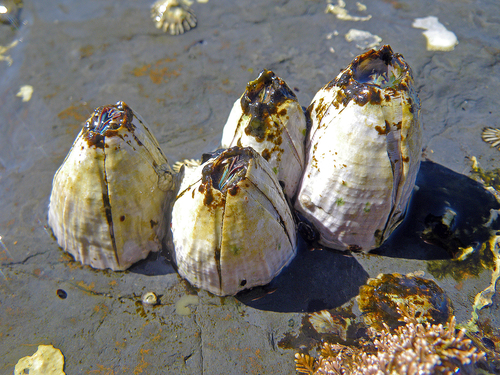
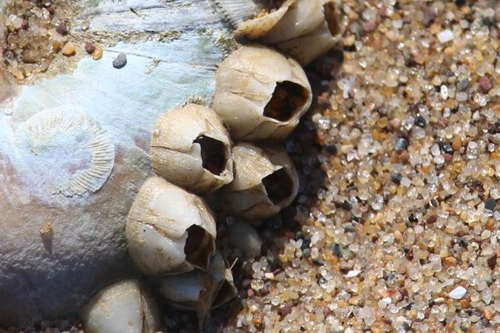
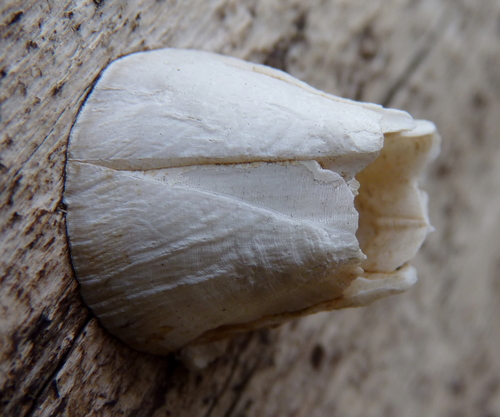
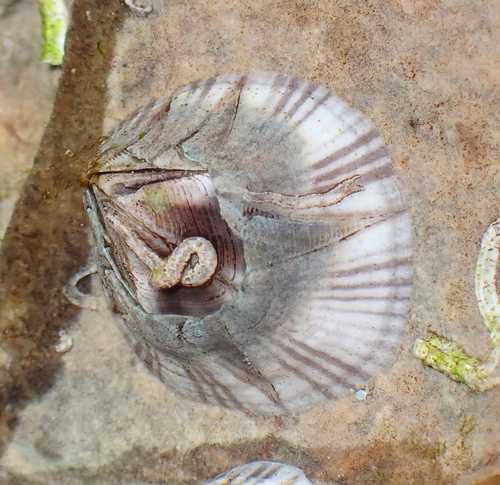
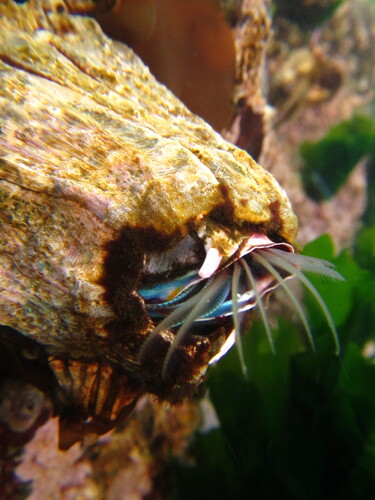
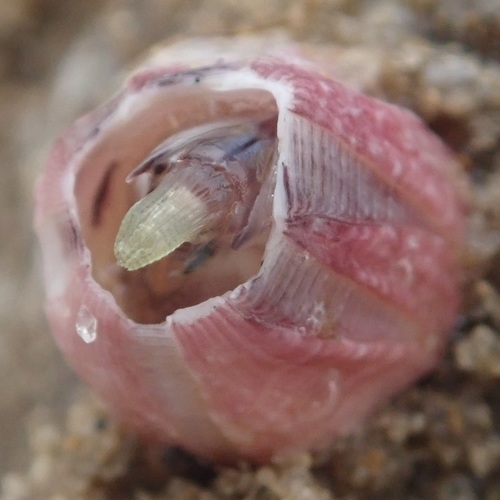
The titan acorn barnacle, with the scientific name Megabalanus coccopoma (Darwin, 1854), is a large barnacle species. Its calcareous plates form a steep-sided cone, growing 5 centimetres (2.0 inches) in both height and width. The smooth, fused plates are pink, separated by narrow purple or white radii, and have a small aperture at the top. In the Pacific Ocean, this species can be confused with Megabalanus californicus, which differs by being darker in colour, having a wider aperture, and having wider rays between its plates. The titan acorn barnacle is native to the Pacific coasts of Central and South America, ranging from Mazatlán, Mexico to the Ecuador/Peru border. It grows on rocks and other hard substrates, from the low tide mark down to about 100 metres (330 ft) deep. Fossil specimens of this barnacle have been found in rocks dating to the Oligocene, and it was present in Baja California in the Pliocene, when the region was located 480 kilometres (300 mi) further south than it is today. This species has expanded its range, likely as part of the fouling community on ship hulls, and was first recorded in Belgian waters in 1997. It is now also found along the United States coast from North Carolina south to Florida, and in the Gulf of Mexico. It was first documented in Louisiana in 2002, and in Florida, Georgia, South Carolina, and North Carolina in 2006. It may be extending its range northward along this coast because higher surface water temperatures allow it to survive and reproduce there. It experienced a population setback in these areas during the cold winter of 2009–10. It first appeared in San Diego in 1985, following the 1982–1983 El Niño event when sea surface temperatures were up to 4 °C (7 °F) above average. To reach San Diego, it likely settled in one or more intermediate locations first, because the distance from its known native range is too great for larvae to drift there in a single season. In 2010, it was recorded for the first time in South Africa, on a buoy near the entrance to the Port of Durban, and the species is likely already present at other sites along this coast.