About Meesia triquetra (L. ex Jolycl.) Ångstr.
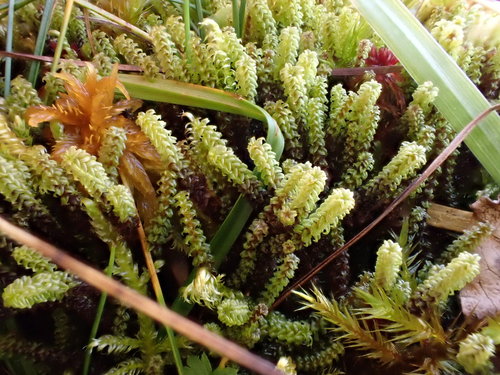
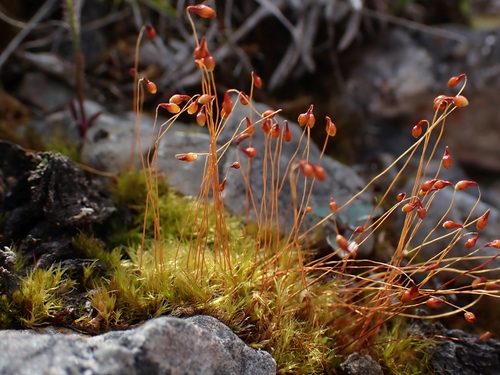
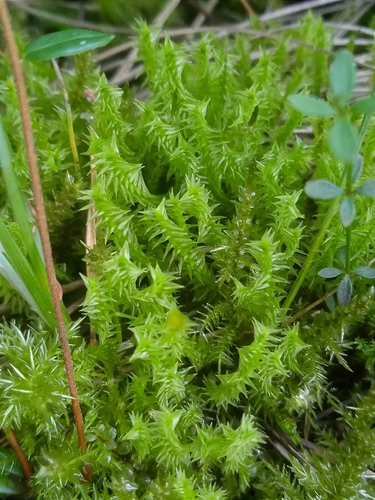
Meesia triquetra (L. ex Jolycl.) Ångstr. grows in small tufts or cushions. Individuals are often large, acrocarpous, and dioicous. Upper parts of the plant are dark-green to grass-green, while lower parts are occasionally red-brown due to dense rhizoids. Stems are unbranched or only little branched, pale-brown to yellow-brown, closely foliate, and reach 2–14 cm high. Leaves are decurrent, squarrose (spreading) when moist, triangular to ovate to lanceolate, somewhat crispate (contorted), 2–3½ mm long, and tristichous (arranged in three obvious ranks). Leaf margins are sharply serrate or denticulate all the way or nearly all the way to the base, and are either plane or sometimes recurved in the middle section of the leaf. The costa is relatively narrow, measuring less than 1/5 the width of the leaf base, and is subpercurrent to percurrent, tapering gradually at its distal end. The leaf apex is acute to acuminate (sharply pointed), and the lamina is unistratose across its entire area. Perigonia of Meesia triquetra are terminal, forming discoid heads. The seta is straight and smooth, brown to yellow-brown, and very long at 4–10 cm. The capsule is asymmetrical and somewhat pyriform, measuring 2¾–5½ mm long including the neck; the hypophysis (neck) is long, making up up to ½ of the total capsule length, is moderately well-defined, and does not wrinkle much when dry. The urn is oblong to short-cylindric, arcuate and asymmetric, brown to yellow-brown, up to 4 mm long, and becomes wrinkled but not regularly sulcate when dry. The operculum is short-conic, and the endostome cilia are often rather well-developed. Spores are finely papillose. Meesia triquetra is easily recognized by its distinct three-ranked leaf arrangement and its dioicous nature. It can be distinguished from Meesia uliginosa by its squarrose leaves, narrow costa relative to leaf base size, serrate planar leaf margins, and acute leaf tips. In contrast, M. uliginosa has a wide costa that reaches up to 1/3 of the leaf base width, entire revolute leaf margins, and blunt apices. All other Meesia species also have blunt apices. This species has a circumboreal distribution: it occurs in Northern Europe, northern Asia, Greenland, Canada, and the northern United States, with some discoveries reported from Oceania. These mosses grow in wetland sites, specifically in the wettest portions of "extreme rich fens" (fens with surface waters that have high pH and high calcium concentrations) within wet woods. Montagnes describes this species as a "rich fen indicator of high fidelity." Common associated species include Scorpidium spp. and Drepanocladus revolvens. The fire ecology of this species is not known; however, fens rarely burn. Excess soot from nearby fires may negatively affect habitat quality. Fire return intervals in conifer bogs, a somewhat similar mire-type habitat, are estimated to be around once every 150–200 years. Fire causes significant damage to peat, but a bog must be dry (during a drought year) to burn, and bogs are typically not dry enough to burn.