About Medialuna californiensis (Steindachner, 1876)
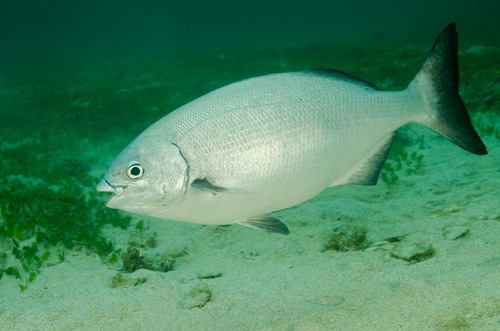
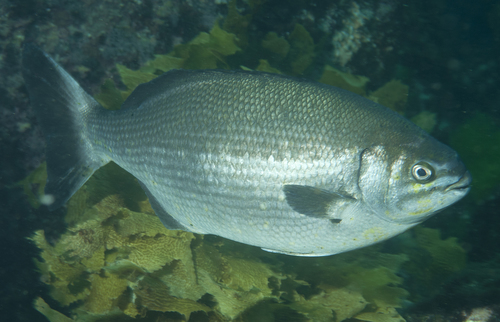
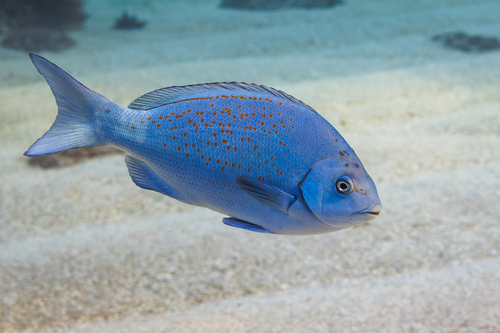
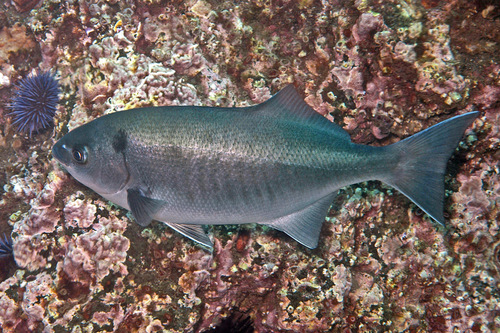
Medialuna californiensis, commonly called the halfmoon, has an elongate, compressed, oval body with a small pointed head. It has a small, horizontal mouth; when the mouth is closed, the upper jaw is partially hidden by the orbital bone. Each jaw holds a single row of pointed teeth. Its dorsal fin is continuous, with 9–11 spines in the anterior section that fold down into a scaly furrow, and 22–27 soft rays in the posterior section, which are longer than the anterior spines. The anal fin has 3 spines and 17–21 soft rays. The caudal fin is slightly concave. Most of the head and body is covered in small, thick, rough scales, with the exception of the area in front of the eyes. Adult halfmoons are dark bluish grey to grey on their dorsal (upper) side, and paler on their ventral (lower) side, sometimes marked with faint, narrow vertical bars along the flanks. They have a dark blotch on the upper corner of the gill cover. The margins of the dorsal, anal, and caudal fins are dark, and the outer edge of each lobe of the caudal fin is white. Juvenile halfmoons are blue on the upper body and silvery on the lower body. The maximum recorded total length of the halfmoon is 48 centimetres (19 in). The common name "halfmoon" comes from the caudal fin's crescent moon-like shape. The halfmoon is native to the eastern Pacific Ocean along the western coast of North America, ranging from Vancouver Island in the north to the Gulf of California in the south; it is rare north of Point Conception, California. Halfmoon are often seen high in the water column over rocky areas, and at middle depths over kelp. Their preferred habitats include rocky reefs, kelp forests, floating kelp pads, and oil rigs. They are occasionally found near the water surface, but most commonly occur at depths between 3 and 40 metres (9.8 and 130 ft). This is an omnivorous species: kelp, red algae, and green algae make up most of its diet, but it also feeds on a variety of small invertebrates including crustaceans, sponges, and sea anemones. Halfmoon are schooling fish. Juveniles are occasionally found far offshore, but they are more common in shallow subtidal areas and kelp beds alongside adults. In their first year, halfmoon can be as small as 2.54 centimetres (1.00 in), and form schools of a dozen or more individuals on the outer edge of kelp beds and in seagrass beds. Halfmoon reach sexual maturity when they grow to around 20 centimetres (7.9 in), at roughly two years of age. Their spawning season runs from June to October, and they are broadcast spawners. Fertilized eggs and newly hatched larvae are planktonic. Larvae are most abundant off northern Baja California. Juvenile halfmoon school with juvenile opaleye beneath floating kelp rafts.