About Meconopsis horridula Hook.fil. & Thomson
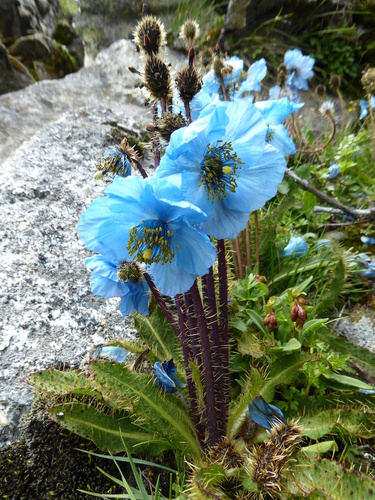
Meconopsis horridula Hook.fil. & Thomson is a species that shows significant natural variation in leaf structure and inflorescence. In wild populations, its flowers grow either solitary or arranged in a raceme. This is a monocarpic species, meaning individual plants die after producing seeds, and it has a plump taproot. The surface of its stems and pedicels are covered in straw-colored spines. It produces basal leaves around 25 cm long, arranged in a rosette. These leaves are either elliptical or narrow-oblong in shape, tapering into their petiole. Leaf margins can be entire, slightly lobed, or toothed; leaves have an attenuate base connecting to the petiole, and an apex that is either obtuse or acute. Both the upper (adaxial) and lower (abaxial) leaf surfaces are covered in yellowish or purplish spines that grow out of purple wart-like structures, and in some cases leaves are covered in bristles instead. Upper leaves on the stem are smaller and shaped like bracts, and the species has deciduous leaves. Its open-faced flowers are most commonly blue or reddish-blue, and very rarely white. Open flowers measure 5 to 7.5 cm across. The flower stalk is usually less than 22 cm long, and it is bent so the flower droops rather than standing upright. Overlapping petals form a broad cup shape; each flower has 4 to 8 oval petals. Sepals have bristles on their adaxial surface. When flowers are solitary, they grow on a scape; in other cases, flowers cluster together in the lower half of the stem. Stamens measure 10 to 14 mm long, and bear greyish-black anthers, with yellow or orange-yellow pollen. Filaments are typically a similar color to the flower petals. The pistil has a 6 to 7 mm long style topped with a yellow stigma. The ovary is conical, with compressed spines on its outer surface. Seeds are small, dark brown, kidney-shaped (reniform) with pointed ends. Seeds develop inside a spiny, capsule pod; the spines on the capsule have thickened bases. The capsule is a domed cylinder that tapers toward one end, and measures 1.5 to 2 cm long and 0.6 to 1.1 cm wide. As a dicot plant, its seeds contain two cotyledons. This species is distributed from western Nepal in the west, through the central and eastern Himalayas, to southeastern Tibet (Xizang) and western China, ranging from western Kansu to Sichuan and northwestern Yunnan. It naturally grows in rocky areas and grass slopes at altitudes between 3100 m and almost 6000 m, growing close to the altitudinal limit for vegetation in this region. In cultivation, it can be grown in slightly shaded or full sun cool locations, in meadow or rocky areas, and can grow alongside shrubs such as rhododendron. It needs abundant moisture during its growing season, does not require winter protection, and can tolerate temperatures as low as -10 degrees F due to its high-altitude native range. Flower color in this species is not affected by soil alkalinity. Meconopsis horridula is used in traditional Chinese herbal medicine for its anti-inflammatory and analgesic properties, and is widely harvested for this purpose. Even though a single plant produces many seeds, germination rates are low in both natural and laboratory conditions. Rising demand for the plant is expected to lead to increased uprooting of wild individuals.