About Mayaheros urophthalmus (Günther, 1862)
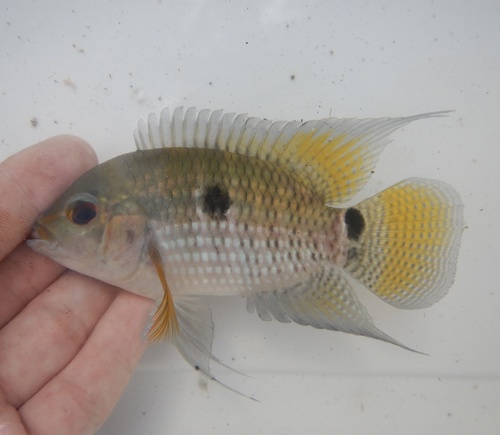
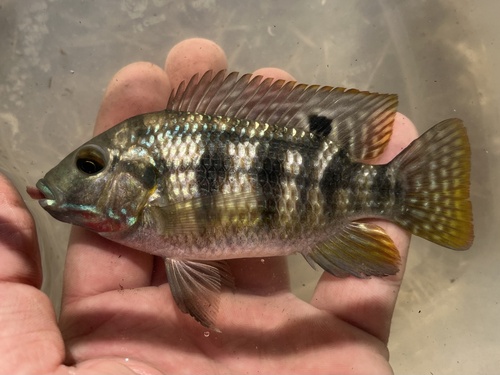
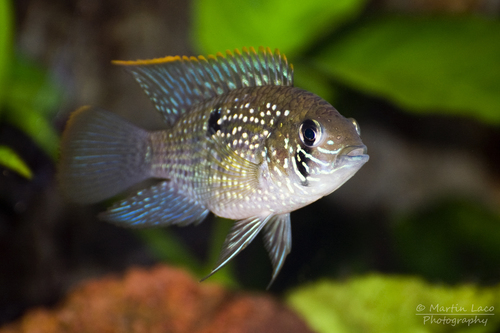
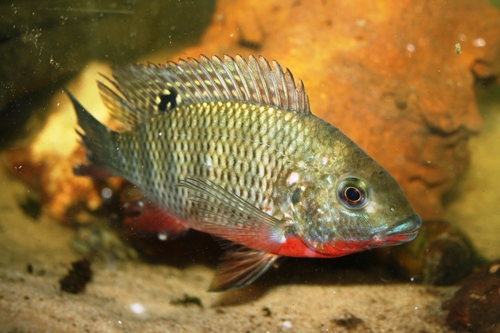
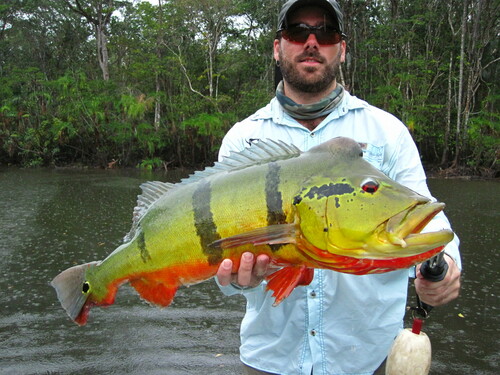
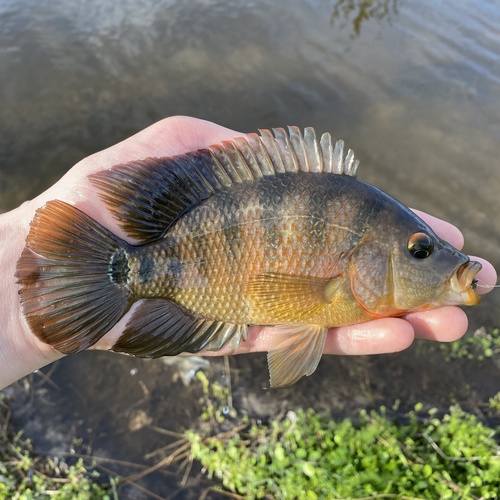
Mayaheros urophthalmus, the Mayan cichlid, is one of the larger cichlid species, reaching a maximum total length of 39.4 cm (15.5 in). It has an oval, laterally flattened body, a head that tapers toward the mouth, and spiny fins. In most cases, its base body color ranges from yellow-brown to gray-brown, and this base color turns an intense red during breeding. The head and throat are reddish, especially in younger individuals. The caudal fin and the soft portions of the dorsal and anal fins are usually more or less reddish. Six wide green-black vertical stripes run along the sides of the body, between the base of the pectoral fin and the base of the caudal fin. A large black eye spot ringed with blue-green sits on the caudal peduncle (tail stem); this feature gives the species its scientific name urophthalmus, from the Greek words oura meaning tail and ophthalmos meaning eye. Because this species has a relatively large distribution, it can appear in a range of color variations that may differ from the description above. This fish is found in Middle America. It is native to the Atlantic slope of tropical Mesoamerica, spanning from eastern Mexico south to Nicaragua. It was first recorded in Everglades National Park, Florida, in 1983, and is now a common non-native fish in South Florida. The Mayan cichlid lives in freshwater marshes, mangrove swamps, lakes, rivers, rocky shorelines, lagoons, estuaries, and coastal islands. Adult Mayan cichlids prefer coastal lagoons and rivers, and can survive in marine conditions. They are most often found in oxygen-rich areas near submerged vegetation, over muddy substrates. While the species prefers waters with a dissolved oxygen content of at least 3.5 mg/L, it can survive extreme hypoxia. It acts as an oxygen conformer, becoming much less active in low-oxygen water, and can even survive near-total anoxia for up to two hours. Unusually, this fish has also been recorded living in some cenotes on the Yucatan Peninsula. When breeding, the Mayan cichlid is territorial and aggressive. It is highly protective of its young and produces multiple broods per year. This species is monogamous, biparental, a substrate spawner, and shows minimal sexual dimorphism. Adults guard their fry for up to six weeks. All of these reproductive traits are highly developed in this species, representing an extreme form of the general reproductive pattern seen in the genus Mayaheros. In Mexico, the Mayan cichlid spawns over a nine-month period from March to November, with spawning occurring most often during the wet season from June to September. This spawning period lines up with when water temperatures reach at least 24 °C. Multiple broods are raised each year. Newly hatched fry are adapted to living in flowing (lotic) water. They show strongly positive geotactic behavior: when they hatch from their eggs, they actively swim down to the substrate, and cling to the bottom using three pairs of mucous glands.