About Mauritia arabica (Linnaeus, 1758)
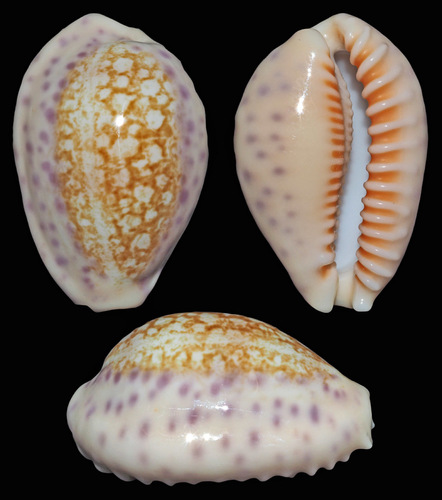
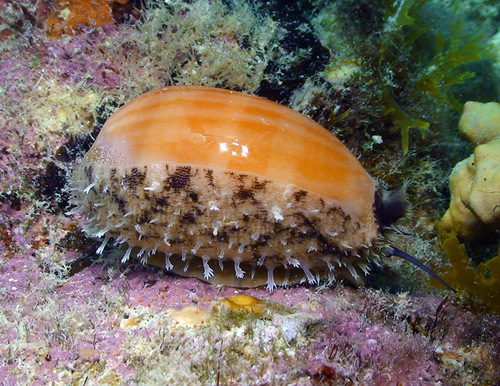
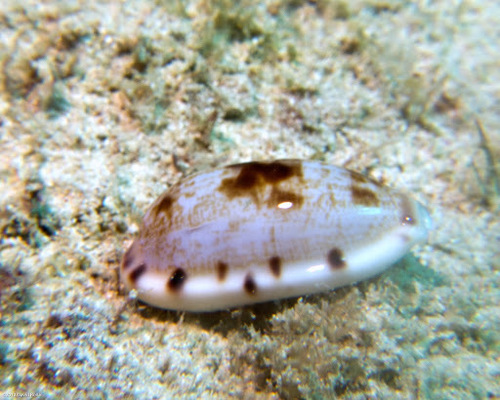
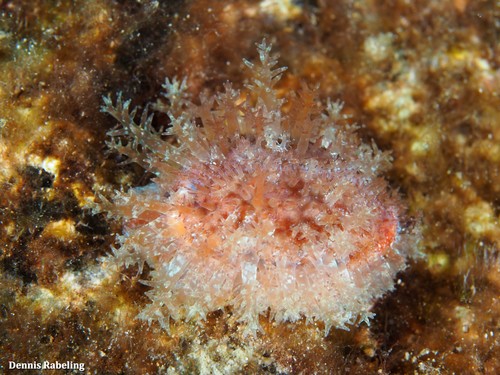
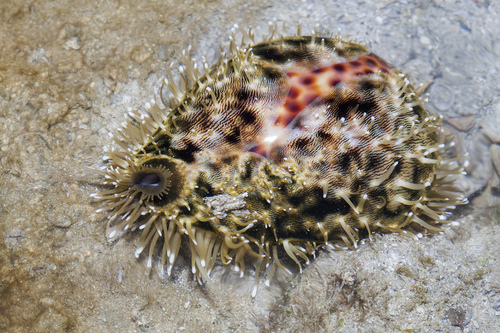
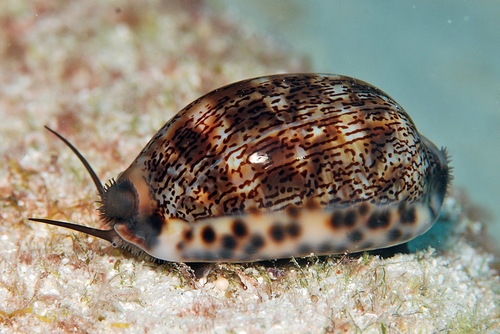
This species, Mauritia arabica, has a maximum shell length of 105 mm, and more commonly reaches 80 mm. Its shell has an oblong or nearly elliptical outline. The spire is barely distinguishable when viewed from the dorsal side. Like other species in the Cypraeidae family, the shell aperture is very narrow and relatively long. Both the inner and outer lips are decorated with arrays of small teeth. The dorsal side of the shell is convex or bent, and never depressed. The dorsal mantle groove, the line or area where the two mantle flaps meet when fully extended, has a different color pattern from the rest of the shell, so it is easily visible. The lateral margins are calloused, especially toward both the posterior and anterior ends. The ventral side of the shell is typically flattened, and sometimes slightly concave. As with the shells of most other Cypraeidae snails, the shell surface is notably shiny, as if it had been deliberately polished. Dorsally, the shell color is generally cream to light fawn, with shades of brown. The ventral side ranges in color from cream to grey. The labral teeth are reddish brown, and turn white toward the columella. Its common name, Arabian cowry, comes from a dense, irregular pattern of thin longitudinal brown lines that are sometimes interrupted by empty spaces, creating an appearance similar to Arabic script. Mauritia arabica has very similar shells to its close relative Mauritia eglantina, and the two are easily confused. M. eglantina has a dark blotch or spot near the spire, which M. arabica lacks, and M. eglantina generally has a narrower shell outline and a more elongate-cylindrical shell shape. Mauritia arabica is widely distributed in the Indo-West Pacific, ranging from East and South Africa (including Madagascar, but excluding the Red Sea and the Persian Gulf) to eastern Polynesia. Its distribution extends north to Japan and south to New South Wales, Australia. This sea snail lives under boulders and stones, and shelters in caverns on the outskirts of coral reefs. It inhabits low intertidal zones to shallow sublittoral depths, and is mainly active during the night. In many areas, local people collect Mauritia arabica for food, and its shell is commonly used in shellcraft.