About Mauremys caspica (Gmelin, 1774)
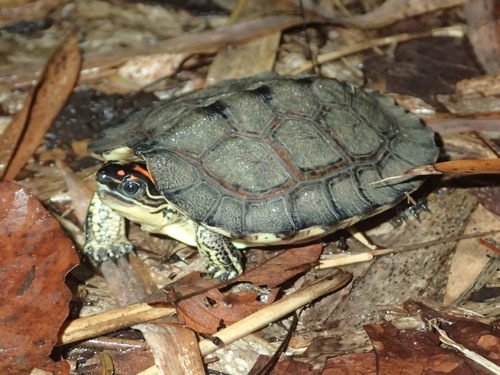
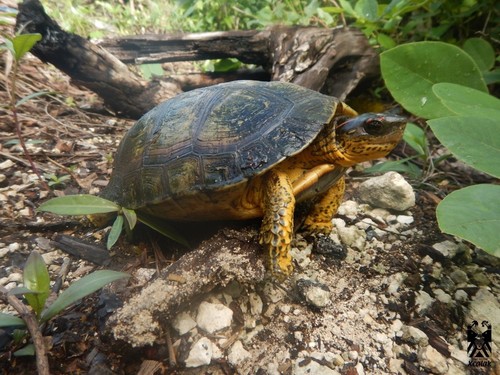
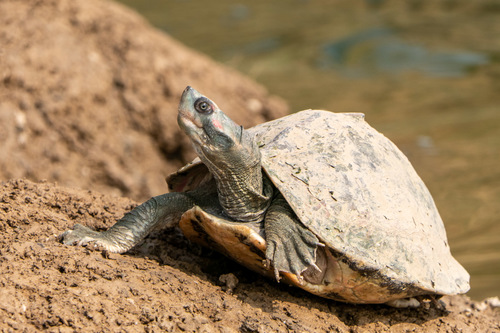
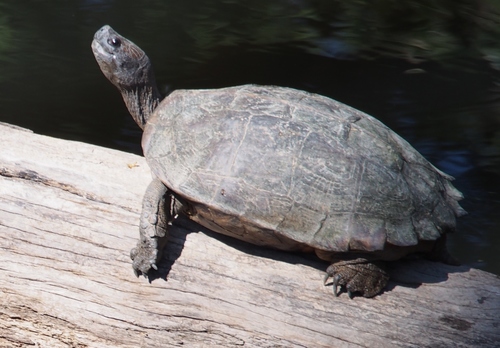
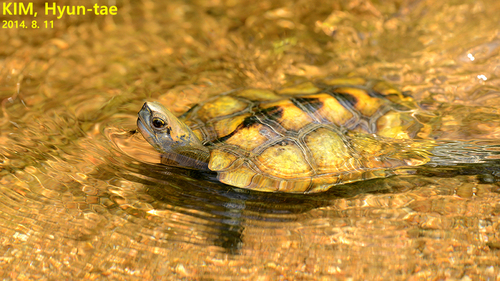
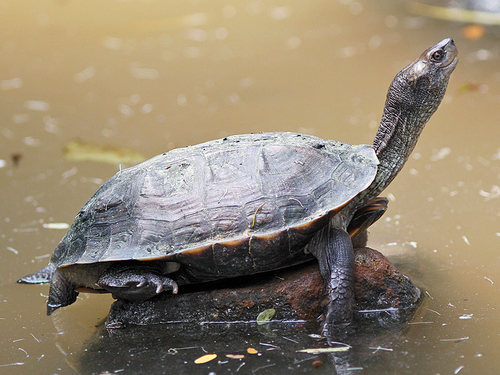
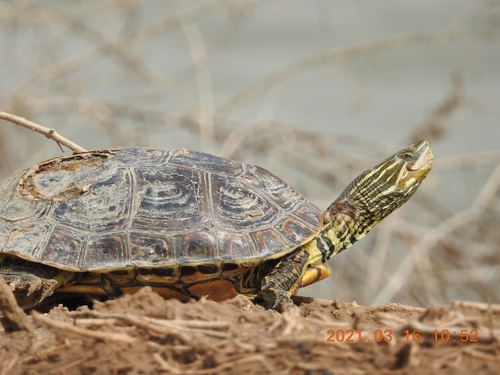
Mauremys caspica is a medium-sized, semiaquatic turtle that ranges in color from tan to blackish, and can reach a carapace length of 25 cm (9.8 in). Its low, oval carapace has a faint medial keel that is more prominent in juveniles, and a smooth, unserrated marginal border that is slightly upturned and tapered above the tail. Hatchlings have a pair of low lateral keels on their pleural scutes, but these keels become lower with age and disappear entirely in adults. The carapace is tan, olive, or black, with yellow to cream-colored reticulated patterns across the scutes; some individuals have yellow vertebral stripes. These light markings fade as the turtle ages, while the borders of the pleural scute seams darken. The well-developed plastron is notched at its posterior end. Details of the plastral formula for this species are provided in the subspecies descriptions under Geographic Variation. The plastron is either yellow with variable reddish to dark-brown blotches, or dark brown to black with a yellow blotch along the lateral borders of the scutes. The bridge is either yellow with dark seam borders and dark spots on the corresponding marginal scutes, or almost entirely black with just a few small yellow marks. The head is not enlarged, and is olive to dark brown with yellow or pale cream-colored stripes. Some stripes extend forward from the neck onto the head; one stripe on each side passes above the eye and onto the snout, where it meets the stripe from the opposite side. Several other stripes extend across the tympanum to connect with the posterior rim of the orbit, and two additional stripes run across the snout and pass below the orbit. The neck, limbs, and tail are tan-gray, olive, or black, with yellow, cream, or gray stripes or reticulations. Mauremys caspica has 52 chromosomes, as documented by Killebrew (1977a) and Bickham and Carr (1983). Females are typically larger than males, have flat plastra, and shorter tails with the vent located under the rim of the carapace. Smaller males have concave plastra, and longer, thicker tails with the vent positioned beyond the rim of the carapace. In its ecological range, Mauremys caspica occurs in large numbers in nearly any permanent freshwater body within its distribution. It also inhabits irrigation canals and is quite tolerant of brackish water. At one site in Iraq, turtles of this species lacked the ability to swim. Instead, they would crawl out of the water periodically to breathe, then slide back in again. A captive turtle from this site could not be induced to swim. Reed concluded this behavior is an adaptation to the extreme variability in surface water supply in the area. Breeding usually happens in early spring, but can also occur in fall. The wild courtship behavior of this species has not been described, but it is thought to be similar to courtship observed in captive individuals. Nesting takes place in June and July. A typical clutch holds four to six elongated, brittle-shelled, white eggs that measure 20–30 x 35–40 mm (1.0 x 1.5 in). Hatchlings have round carapaces about 33 mm (1.3 in) long, and have brighter coloration than adult turtles. Caspian turtles may form large populations in some areas, particularly in permanent water bodies. In temporary waters, they must aestivate in mud during summer, and more northern populations hibernate through winter. They often bask, but will disappear at the slightest disturbance. Each year, many Caspian turtles are impacted by humans who collect their eggs to treat common eye ailments; storks and vultures also kill large numbers of juveniles and adults respectively. Juvenile Mauremys caspica are carnivorous, and shift to an omnivorous diet as adults; larger individuals have been observed to be more herbivorous. They feed on small invertebrates, aquatic insects, amphibians, carrion, and a variety of aquatic and terrestrial plants.