About Matteuccia struthiopteris (L.) Tod.
Scientific name: Matteuccia struthiopteris (L.) Tod.
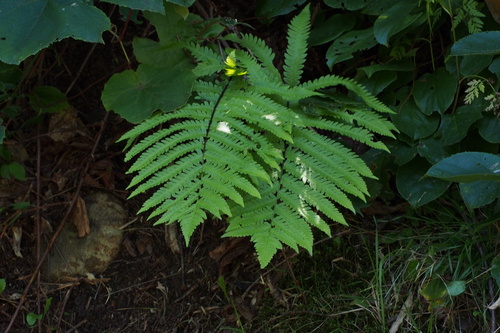
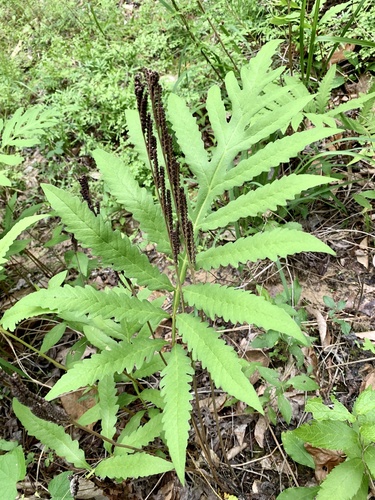
Description: This fern has two distinct types of fronds. The deciduous green sterile fronds grow almost vertically, reaching 100–170 cm (39–67 in) tall and 20–35 cm (7.9–13.8 in) wide. They taper gradually toward the base but taper only a short distance toward the tip, giving them a shape that resembles ostrich plumes — this resemblance is the source of the fern's common name. The fertile fronds are shorter, at 40–65 cm (16–26 in) long. They turn brown when they reach maturity, with highly modified, narrowed leaf tissue that curls over the sporangia. Fertile fronds develop in autumn, stay standing upright through winter, and release their spores in early spring. Alongside Dryopteris goldieana, this species is one of the largest fern species native to eastern North America.
Distribution: This is a crown-forming plant that grows in colonies. It occurs in temperate regions of the Northern Hemisphere, found in central and northern Europe, northern Asia, and northern North America. It grows from a fully vertical crown, and favors growing on riverbanks and sandbars. It produces lateral stolons that grow into new crowns, which allows it to form dense colonies that can resist destruction by floodwaters.
Cultivation and uses: Ostrich fern is a popular ornamental plant for garden planting, and has received the Royal Horticultural Society's Award of Garden Merit. When choosing a planting location, gardeners should note that this fern spreads very widely, and its fronds often lose their attractive appearance over the course of summer, especially if they are not sheltered from wind and hail. Tightly coiled immature fronds, called fiddleheads, are eaten as a cooked vegetable, and are considered a delicacy primarily in rural areas of northeastern North America. It is not considered safe to eat these fiddleheads when they are uncooked. The brown inedible "scales" on fiddleheads should be scraped or rinsed off before consumption. Fiddlehead sprouts are also harvested across Japan, where they are called "kogomi", as well as in other Asian regions, and are considered a delicacy there too. Additionally, in Norway, fiddleheads were historically used to make beer, and in Russia, they were used to control gut parasites. Larvae of some Lepidoptera species, including Sthenopis pretiosus, use Matteuccia species as food plants.