About Matricaria discoidea DC.
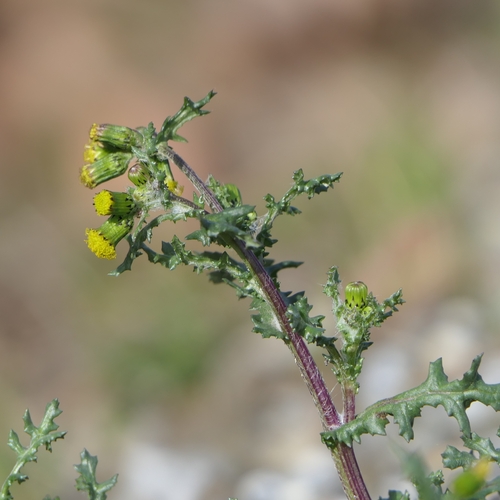
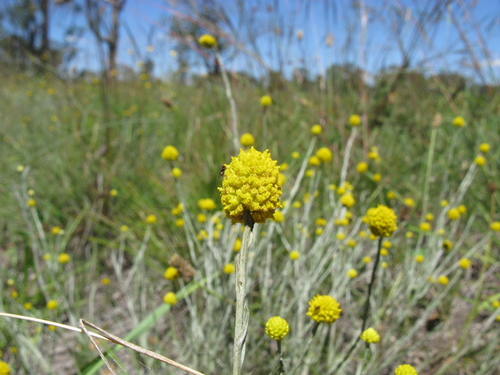
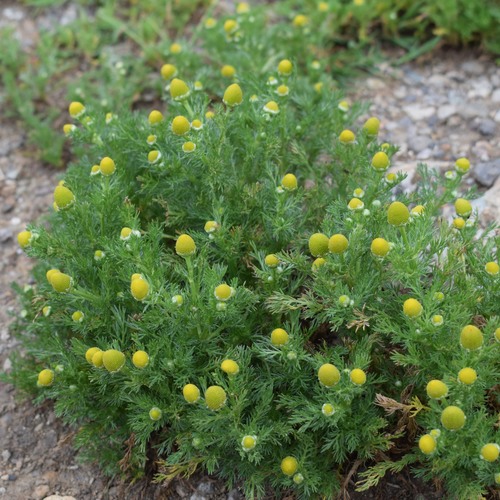
Matricaria discoidea DC. produces small, dome-shaped capitula (flower structures that look like single flower heads) made up of densely packed yellowish-green corollas. Each plant typically bears at least five capitula, with each capitulum measuring 5–15 mm across. This species has no ray florets, giving the flowers a distinct button-like appearance. Capitula are usually solitary or arranged in loose clusters, and are held by short peduncles around 5–10 mm long. Papery, small leaf-like bracts surround each capitulum in three rows, with membranous margins and rounded tips. As a member of the Asteraceae family, it produces florets with an inferior ovary. The hollow, conical receptacle holds numerous tubular, bisexual disc florets, each with five stamens and a pistil formed from two fused carpels. Like other Matricaria species, it has flattened, penicillate style branches that assist with pollen transfer. Flowerheads are produced from March to September. Its leaves are pinnately divided one to three times, with leaf blades measuring approximately 10–65 mm long and 2–20 mm wide. As an annual species, its leaves senesce along with the rest of the plant at the end of each growing season. While the foliage appears glabrous to the naked eye, high magnification reveals many microscopic trichomes, each made of a short basal cell and a long, pointed terminal cell. Microscopically, the leaves are amphistomatic: stomata are present on both the adaxial (upper) and abaxial (lower) leaf surfaces. The stomata sit close to the epidermis and are flanked by oval-shaped guard cells. The cuticle is thin, around 2.6 μm, and leaf surfaces show little difference between the top and bottom. On average, the upper leaf surface has 205 stomata per square millimeter, while the lower leaf surface has an estimated 142 stomata per square millimeter. Internally, leaves contain one large and two medium vascular bundles, plus accessory bundles and secretory canals (resin ducts) distributed throughout the mesophyll. Consistent with most Asteraceae, M. discoidea uses the C₃ photosynthetic pathway. M. discoidea has a shallow root system, consisting of a short, thick taproot with many fine secondary fibrous roots. The taproot grows directly downward from the seed embryo. The plant thrives in disturbed areas, especially those with poor, compacted soil, and often blooms along footpaths and roadsides in spring and early summer. It occurs across Canada and the United States, and is a particularly common weed in Alaska, the Yukon, and the Northwest Territories. There is ongoing scientific disagreement over whether it originated in North America or Siberia. This species has been introduced to Europe, Asia, Iceland, South America, and New Zealand; it is now widespread and naturalized in Britain, where it became one of the fastest-spreading plants of the 20th century. M. discoidea reproduces exclusively by seed. Its flower heads produce small, light brown, ribbed seeds that measure 1.3–1.6 mm in length, less than 0.7 mm in width, and weigh 0.14 mg on average. Each seed is covered by a 19.6–22.8 μm-thick seed coat and held within a small, dry, indehiscent fruit called an achene. Flowering occurs quickly under favorable conditions. In temperate regions like England, M. discoidea may flower only 37–50 days after seedling emergence, with timing varying based on temperature and day length. Shorter photoperiods and later-season germination extend the time to flowering, and plants often overwinter as a rosette before blooming the following spring. Individual flower heads produce 50 to 400 seeds. In the United Kingdom, a whole plant can produce up to six thousand seeds, while in Alaska a main plant usually produces 11 to 1000 seeds. Pineapple weed (common name for this species) readily self-fertilizes, and the species typically produces seeds one or more times per year. Buried M. discoidea seeds lose viability quickly at an estimated rate of 15% per year over the first ten years, though they generally remain viable for a minimum of three years. Seed dormancy also declines steeply in the initial years after burial. Successful germination requires light and open, disturbed soil, as seeds buried too deeply cannot sprout. Seeds are very easily dispersed by water, adhesion to animals, human activity, and motor vehicles. A study by Dunmail J. Hodkinson and Ken Thompson found that M. discoidea is one of the most common plants transported via these routes. The roots of M. discoidea are colonized by arbuscular mycorrhizal fungi, which give the plant greater access to water and nutrients including phosphorus, nitrogen, sulfur, and trace elements. Even though M. discoidea can self-pollinate, insect pollination also occurs. Its pollen has been found in the brood cells of Megachile versicolor, a species of leafcutter bee. Butterflies are also known to drink nectar from flowers of Matricaria species. The plant’s greens can be washed and eaten, and both the flowers and the whole plant can be steeped to make tea, described as "excellent" by one field guide. The plant’s parts have also been used in salads, though they may become bitter once the plant blooms. Extracts from the flowers and other aerial plant parts have been shown to have non-toxic, pain-relieving, and mildly sedative effects, which reflects the biological activity concentrated in the floral tissues.