About Mastocarpus stellatus (Stackhouse) Guiry, 1984
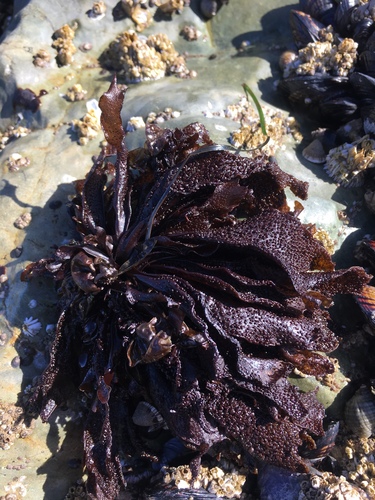
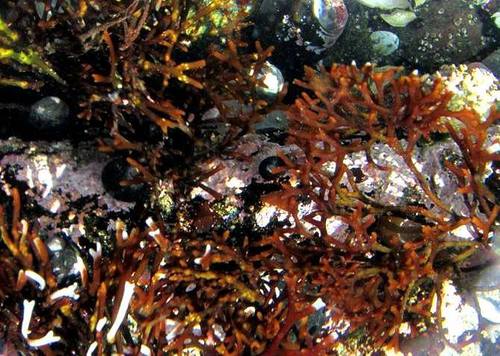
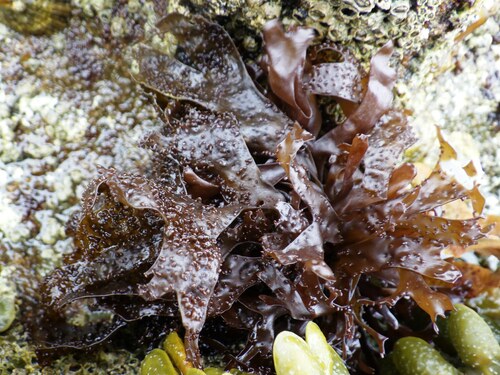
Mastocarpus stellatus (Stackhouse) Guiry, 1984 grows from a discoid holdfast stipe. Its fronds are channeled, unlike the flat fronds of Chondrus crispus. It reaches a height of 10–20 cm (3.9–7.9 in) and branches dichotomously. The frond is cartilaginous and generally reddish-brown, with greenish or purplish tinges; mature individuals may also be reddish brown, purple, or bleached. Mature individuals develop reproductive structures on erect filaments up to 1 mm (0.039 in) in diameter, a feature that readily distinguishes this species from Chondrus crispus.
M. stellatus is commonly found growing on rocks in the mid-intertidal and lower-intertidal zones. It occurs generally on all coasts of Ireland and Britain, with the possible exception of parts of eastern England: Lincolnshire, Norfolk, and Suffolk. Other recorded locations include Iceland, the Faeroes, the coastline from North Russia to Rio de Oro, and the Atlantic coastline from Canada (Newfoundland) to the United States (North Carolina). This species is able to coexist with C. crispus on the northern New England coast, even though it is a weaker competitor than C. crispus. A higher tolerance to freezing allows it to grow in zones above C. crispus in northern environments with significant freezing stress. On the United States Atlantic coast, M. stellatus is rarely found south of Cape Cod, because lower freezing stress means it is outcompeted by C. crispus.
In 1979, Michael Guiry and John A. West conducted a study that determined M. stellatus exhibits two distinct biological life cycles and reproductive processes: the first is heteromorphic, and the second is direct. M. stellatus with the heteromorphic life cycle are broadly dioecious, and reproduce sexually via an alternation of generations between diploid crustose tetrasporophytes and foliose gametophytes. M. stellatus with the direct life cycle reproduce asexually, as fertilization never occurs. This leads female gametophytes to produce carpospores, which grow into new foliose plants that lack tetrasporangia. Tetrasporangia are critical for sexual reproduction, as meiosis within these structures produces four unique tetraspores that develop into male or female gametes. Because asexually reproducing M. stellatus do not develop tetrasporangia, they are genetically isolated from sexually reproducing populations of the species.
According to Michael Guiry, the earliest record of Irish seaweed collection comes from 12th century poems written by monks. A 2001 market analysis of Irish seaweed aquaculture estimated that the combined annual national harvest of M. stellatus and C. crispus was less than 100 tonnes. M. stellatus is harvested during its gametophyte life phase, because later phases of the alga, which contain more sulphated carrageenan, are harder to remove from their rocky substrate.
The food and pharmaceutical industries use this seaweed for its antioxidant, anticoagulant, and thickening or gelling properties. These antioxidant and anticoagulant properties depend on sulfation level, molecular weight, the position of sulfate groups, sugar composition, and glycosidic branching. The gelling properties of M. stellatus can be used to create biodegradable films, which may serve as a sustainable, edible alternative to plastic for food preservation and functional food development.
Carrageenan (a type of phycocolloid) is a sulfated linear polysaccharide made up of carrageenan and carrageenan precursors. To make carrageenan compounds useful for applications, kappa and/or iota carrageenan must be isolated from their mu-carrageenan or nu-carrageenan precursors. Lower molecular weight combined with higher sulfate content produces stronger antioxidant properties, while higher molecular weight combined with higher sulfate content produces stronger anticoagulant properties. The relationship between antioxidant and anticoagulant mechanisms in M. stellatus suggests that inflammation and coagulation are interconnected and interdependent processes. M. stellatus has been used in home remedies to treat coughs, colds, and sore throats, when mixed with C. crispus and other herbs, spices, and sweeteners.