About Mastocarpus papillatus (C.Agardh) Kützing, 1843
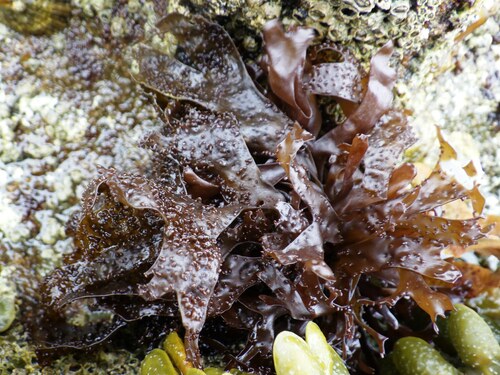
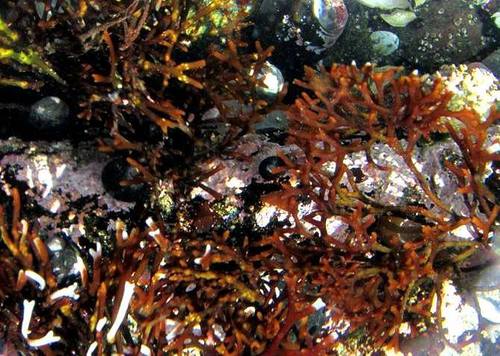
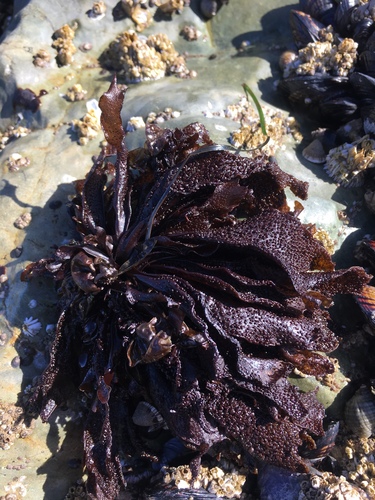
Mastocarpus papillatus, commonly called Turkish washcloth, has a body color ranging from reddish-brown to almost black. Males are paler than females, and do not have the characteristic papillae on their blades. The blades are branched and small, less than 15 cm long, which matches the species' diminutive common name. Early spring blades are thin, purple, and lack papillae. Later in the year, the thalli dry out and turn grey, taking on a lifeless appearance. This species is easily confused with the similar species Mastocarpus jardinii. Male M. papillatus also closely resemble Mazzaella affinis in thallus shape and color, but Mazzaella affinis is smaller, grows in thick mats instead of as individual plants. M. papillatus can also be confused with other species that have a Petrocelis phase, such as Pikea, other Mastocarpus species, Ralfisa, and Hildenbrandia. Both Ralfisa and Hildenbrandia have thinner crusts than the Turkish washcloth crust. Despite its common name Turkish washcloth, this species does not grow near Turkey. It is native to the northeastern Pacific Ocean, and is commonly found in California, Oregon, Washington, British Columbia, and Alaska. It has been recorded as far north as the Commander Islands and the Russian Far East, and as far south as Chile. It grows on rocky substrates in high- to mid-intertidal zones, and has been found at depths of up to 250 m. Like many red algae, it uses the pigment phycoerythrin for photosynthesis, which lets it grow deeper than plants that use other photosynthetic pigments. M. papillatus has a relatively complex reproductive cycle. Male gametophytes release nonflagellated sperm that drift with water currents until they attach to the trichogynes of female plants. Once attached, the sperm undergo mitosis without cell division, developing into a spermatium. Fertilization then occurs through a fertilization pore between the trichogyne and the spermatium. The fertilized eggs grow into tetrasporophytes that are roughly identical to their parent plants. Alternatively, tetrasporophytes enter the Petrocelis phase – a stage originally thought to belong to the distinct genus Petrocelis in the family Phyllophoraceae – where they grow into a crust that looks like spilled tar, giving this species the additional common name black tar spot. The tetrasporophyte undergoes meiosis to produce tetrasporangia, which release spores that germinate in new locations. Eventually the crust grows into a typical adult M. papillatus plant. This crustose Petrocelis phase is shared by all members of the genus Mastocarpus, as well as species in the genus Pikea. Turkish washcloth is a food source for many animals, including Echinolittorina ziczac, Littorina, Amphipoda, Lottia, Pholis crassispina, Lottia scutum, Trochidae, Lacuna vincta, Stenosoma, Mopalia swanii, and Cryptochiton stelleri. Like Porphyra species used to make nori, M. papillatus can become infected by the parasitic oomycete Pythium porphyrae, which causes red rot disease that can kill large colonies. It is also susceptible to infection by Pythium marinum. This alga, also called grapestone, is edible, and can be cooked in soups or stir-fries. Cooks must take care when preparing it, because overcooking will turn the plant mushy and gelatinous. This gelling property can be intentionally used as a thickening agent, similar to how its close relative Mastocarpus stellatus is used. Grapestone has a flavor similar to oysters. It is easily foraged from shorelines, but overharvesting is possible like with any wild species. Foragers can avoid killing the entire organism by grabbing longer blades and pulling sideways, which leaves shorter blades and the holdfast attached to the rock to continue growing. M. papillatus is also reported to have antimicrobial properties.