About Mastigoproctus tohono Barrales-Alcalá, Francke & Prendini, 2018
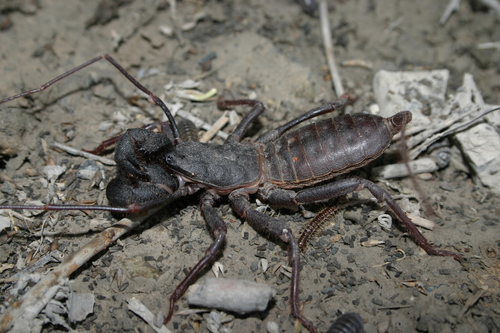
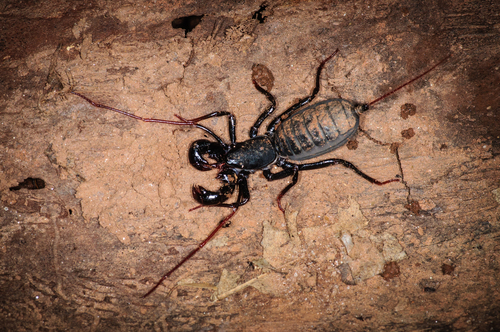
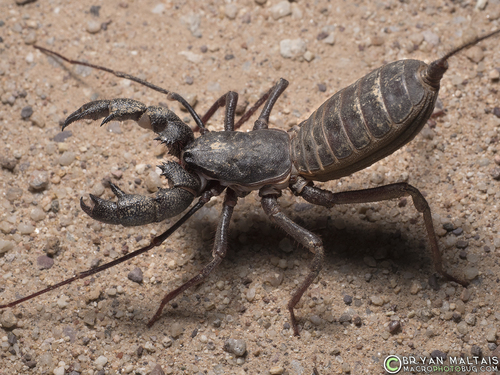
Mastigoproctus tohono, commonly known as the Tohono whip scorpion or vinegaroon, is a species of uropygid described in 2018 by Barrales-Alcalá, Francke and Prendini. Excluding the tail, this species measures 56 to 59 millimeters (2.2 to 2.3 inches) in total length. Its carapace ranges in color from dark reddish brown to black, while its antenniform front legs are typically reddish brown. This species is distinguished by its unique morphology and defensive capabilities. It has six walking legs, plus two modified antenniform front legs. These front legs are covered in sensitive sensory setae, which the species uses to detect prey and environmental vibrations. Its pedipalps are modified into claw-like structures that function to capture and crush prey. Like other whip scorpions, M. tohono has a long, thin, whip-like tail that gives the group its common name of whip scorpion. The species has eight total eyes: one pair positioned on the front of the head, and three smaller eyes on each side of the head. Despite having multiple eyes, its vision is extremely poor. It primarily relies on its elongated front legs, tail, and pedipalps to navigate and sense its surroundings. As a defensive mechanism, Mastigoproctus tohono can spray an acetic acid-based substance from the base of its tail. This substance can damage the exoskeleton of invertebrate attackers, and irritate the eyes and nose of vertebrate predators. The chemical spray produces a strong, vinegar-like odor, which gives this species its alternate common name "vinegaroon".