About Mastigoproctus giganteus (Lucas, 1835)
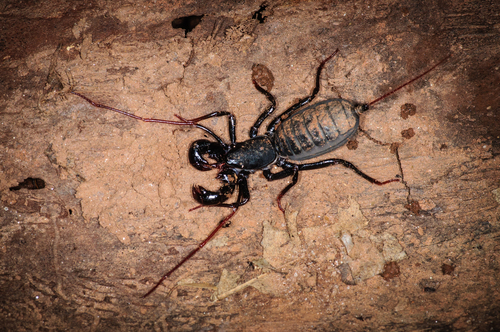
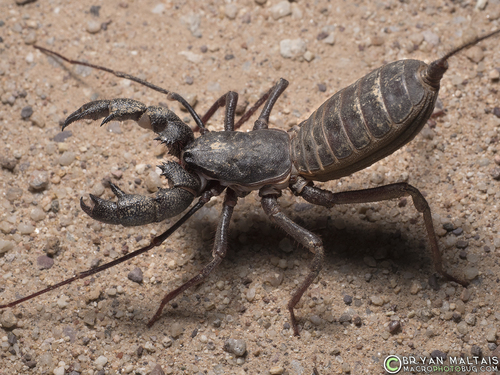
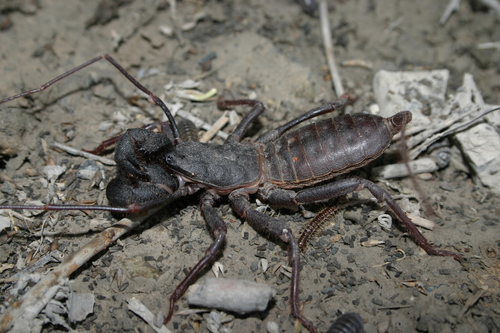
Mastigoproctus giganteus (Lucas, 1835), commonly called whipscorpion or vinegaroon, reaches 40–60 millimetres (1.6–2.4 in) in length when the tail is excluded. It has six walking legs for movement, two long antenniform front legs used to feel for prey and detect vibrations, and two large pedipalps modified into claws to crush prey. It has a long, thin, whip-like tail, which gives the species its common name whipscorpion. For defense, it can spray an 85% acetic acid substance from the base of this tail. Since acetic acid is the main component of vinegar, this spray smells strongly of vinegar, giving the species its other common name "vinegaroon". Mastigoproctus giganteus has eight eyes total: one pair at the front of the head, and three more on each side of the head. Its eyes are very weak, so the species navigates mostly by sensing with its long front legs, tail, and pedipalps. This species lives in the southern United States and Mexico, at elevations up to 6000 meters. In the United States, it is the only species from the family Thelyphonidae found in the country, occurring in Arizona, Florida, New Mexico, Oklahoma, and Texas. It is a nocturnal, efficient predator that preys on a range of animals including various insects, worms, slugs, arthropods, primarily insects such as cockroaches and crickets, plus millipedes, other arachnids, and even has been recorded feeding on small frogs and toads. It is an efficient predator of scorpions, and people sometimes keep it for this purpose. It uses its large pedipalps to hold prey, while its chelicerae tear and bite the prey. Its own predators include raccoons, coatis, armadillos, skunks, bears, hogs and peccaries, ground birds such as roadrunners, lizards, and tarantulas. Mastigoproctus giganteus typically lives 4 to 7 years. Females only reproduce once, producing around 40 offspring. The mother protects and feeds her young in their early lives, which improves the young's survival rate. Males fight each other fiercely at night to win mating access to females, and mating also occurs at night.