About Mastigias papua (Lesson, 1830)
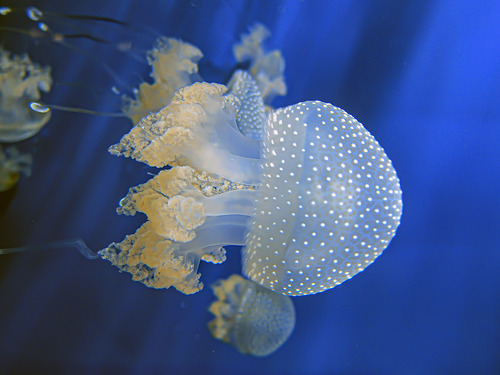
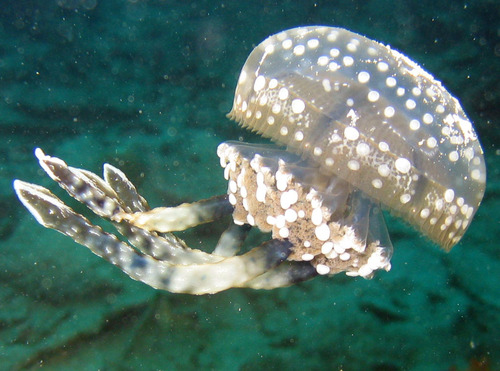
Description: The spotted jelly, Mastigias papua, has distinctive spots on the top of its bell. Its body color ranges from greenish blue to olive green, a trait caused by symbiotic zooxanthellae that live in its tissues. There are eight sensory structures called rhopalia along the margin of the bell. The bell averages around 10 cm (3.9 in) in diameter, and can grow as large as 30 cm (12 in). This jellyfish has 8 frilled oral arms, each of which ends in a club-shaped appendage. The upper surfaces of these arms are covered in stinging cells called cnidocytes. Unlike many other jellyfish, spotted jellies have many small mouths along the underside of their oral arms. Insular populations that live in marine lakes, such as that on Kakaban Island, have altered morphology compared to populations that live in the open ocean. One key change is reduced tentacle length: even though lake-dwelling jellyfish can be over three times larger in bell diameter than ocean-dwelling individuals, their tentacles are similar in length to those of ocean-dwelling spotted jellies. Their nematocytes (stinging cells) have also atrophied, and local environmental conditions are thought to denature the protein-based venom that Mastigias papua produces. As a result, marine lake populations of this jellyfish do not sting humans and are harmless to touch. Habitat: Spotted jellies are found across the entire Indo-Pacific region, ranging from the Fijian archipelago west to the western Indian Ocean, and from Japan south to Australia. Some populations in Palau form very large groups called "smacks", and these groups have become popular tourist attractions. The most famous location to view these aggregations is Ongeim’l Tketau Lake in Palau, which is also known as Jellyfish Lake.