About Masticophis flagellum (Shaw, 1802)
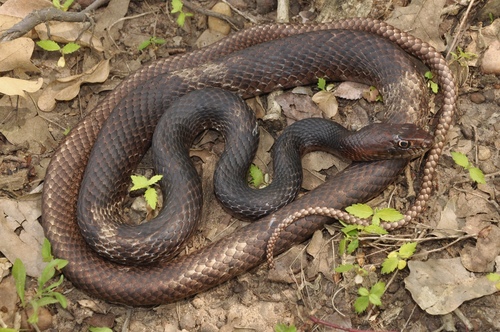
Coachwhips (scientific name Masticophis flagellum (Shaw, 1802)) are thin-bodied snakes with small heads and large eyes that have round pupils. Their color varies greatly, and most have coloration that works as effective camouflage for their natural habitat. The subspecies M. f. testaceus is typically a shade of light brown with darker brown flecking, but in western Texas, where soil is pink, these coachwhips are also pink in color. The subspecies M. f. piceus got its common name because its specimens frequently, though not always, have some red in their coloration. When looking at coachwhip scales from a distance, their pattern gives the snake a braided appearance. Subspecies can be hard to tell apart in regions where their ranges overlap. Common total adult length (including the tail) falls between 127–183 cm (50–72 in). The largest recorded specimen, from the eastern coachwhip race, reached a total length of 259 cm (102 in). Young specimens just over 100 cm (40 in) long weigh between 180 and 675 g (6+1⁄2 to 24 oz). Large mature adults measuring 163 to 235 cm (64 to 93 in) weigh 1.2 to 1.8 kg (2 lb 10 oz to 3 lb 15 oz). Coachwhips are distributed across the entire southern United States from coast to coast, and also occur in the northern half of Mexico. They are commonly found in open areas with sandy soil, open pine forests, old fields, and prairies. They thrive in sandhill scrub and coastal dunes, but prefer oak savannas in eastern Texas. This species can tolerate isolated, buffered habitat fragments, but habitat configuration and edge exposure may negatively impact how viable an area is for coachwhip habitat use, as this is a sensitive species.