About Mastacembelus armatus (Lacepède, 1800)
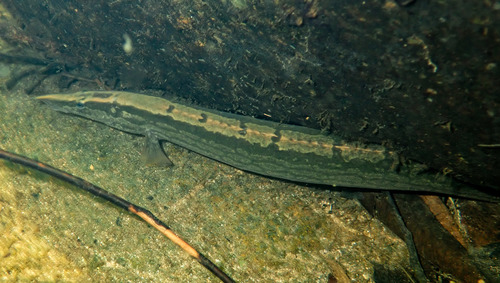
Mastacembelus armatus (Lacepède, 1800), commonly called the zig-zag eel, is a large elongated fish with a snake-like body that lacks pelvic fins. Its anal and dorsal fins are elongated, and both connect to the caudal fin. Numerous spines sit in front of the dorsal fin. Black dots on either side of the dorsal fin mimic the pattern of the sandy and rocky substrates the fish lives among, helping it hide from predatory fish that swim above looking down. The back of this species is dark beige, while the head is silver-beige; the main body is dull brown, and the belly is a lighter shade of brown. These brown tones help the zig-zag eel conceal itself from both predators and prey in the turbid water environments it inhabits. The body may also have brown circular markings, and one to three darker longitudinal zigzag lines that connect to form a distinct reticulated pattern. This patterned area is limited to the dorsal two-thirds of the body. Brown stripes run laterally through each of its eyes. Zig-zag eels do not have gill rackers, an adaptation to their predatory diet. In its natural habitat, Mastacembelus armatus can grow up to 36 inches (91 cm) long, but it usually does not exceed 20 inches (51 cm) when kept in captivity. In the wild, adult males typically measure 37 to 49 cm long, adult females 40 to 52 cm, and juveniles 14 to 27 cm. This species has unique internal physiological variations that show adaptation to its specific environmental niche. It has two pairs of nostrils that help it detect changes in its turbid water surroundings, as well as chemical cues from food, making it an effective ambush predator. Its elongated snout holds tube-shaped anterior nostrils, while oval-shaped posterior nostrils sit near the eye. Mastacembelus armatus has interspecific variation in the number of olfactory lamellae, the structures that support scent recognition in fish. Individual fish have between 60 and 76 olfactory lamellae. A zig-zag eel's age can be determined from its body length and the radius of its scales, which have a linear relationship with age. As these fish age, they develop growth rings called annuli on their scales. These rings form each year during the monsoon season, when changes in food availability and spawning pressures slow the fish's growth. Wild-caught zig-zag eels have a maximum average of four annuli on their scales, indicating a typical wild longevity of four years. Despite its eel-like body shape, Mastacembelus armatus is not a true eel, because it belongs to the order Synbranchiformes rather than Anguilliformes. Mastacembelus armatus is a nocturnal species that thrives in highland streams, lowland wetlands, still waters, coastal marshes, and rivers with sandy or rocky riverbeds and heavy vegetation. It is a potamodromous fish that migrates within river and stream systems. This migratory behavior creates genetic variation between populations that are not connected by river systems or do not interact along their migratory routes. Most zig-zag eels tolerate a pH range of 6.5 to 7.5, and prefer tropical water temperatures between 22 and 28 °C. However, some populations live in higher elevation rivers fed by snowmelt from the Himalayas, and can withstand much cooler water temperatures. The species is common during tropical summer months, and lives in canals, lakes, and other floodplain areas during the flood season. Mature male and female zig-zag eels can be distinguished from each other; females are typically plumper than males. The species has relatively low fecundity, which makes it vulnerable to overfishing exploitation and population decline caused by pollutants. In natural habitats, these fish spawn underneath rocky substrates during the monsoon season. No successful captive breeding programs for this species are known to exist, but efforts are ongoing to expand knowledge of successful captive breeding to support the use of Mastacembelus armatus in aquaculture.

