About Marshallia mohrii Beadle & F.E.Boynton
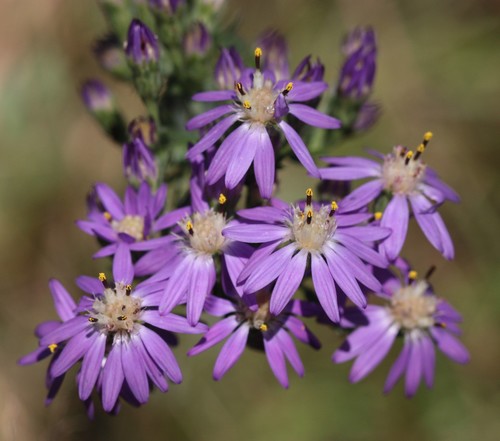
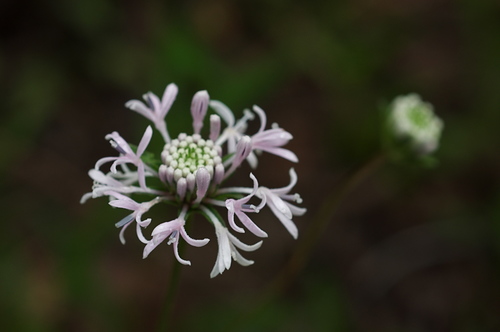
Marshallia mohrii, commonly called Mohr's Barbara's buttons, grows to a height of about 1–2.5 feet. Its tubular flowers are 2.5 cm wide, arranged in groups of 2 to 6 flower heads, and can be white, pale pink, or lavender. Its leaves are lanceolate to ovate in shape, measuring 6–10 cm long and up to 2 cm wide, with three parallel veins. Leaves are larger and more abundant near the base of the stem. The species typically flowers from mid-May through June, and produces fruit in July and August. Its fruit is a 5-angled, 10-ribbed achene around 4 mm long, with a hairy surface covered in resin dots. The fruit is topped by a crown (pappus) of five narrowly triangular, sharply pointed scales that are 1–3 mm long. Fruits are held among sharply pointed bracts (chaff) that remain on the flower head. This species requires wet, sandy clay soils with alkaline pH and high organic matter content. Most currently known populations grow in soils of the Conasauga-Firestone Association. It is most often found along shale-bedded streams, particularly in seasonally moist forest gaps, and in low swales that extend onto roadside rights-of-way. Mohr's Barbara's buttons can survive in both full sun and partial shade, and often grows in association with grass-sedge communities. Two other endangered species, the Alabama Leather-Flower (Clematis socialis) and the Green Pitcher Plant (Sarracenia oreophila), share the same limited habitat requirements as Marshallia mohrii.