About Marmota vancouverensis Swarth, 1911
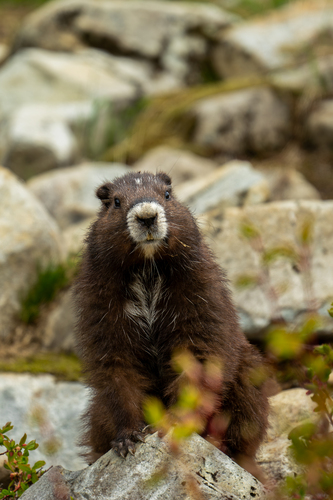
Marmota vancouverensis has a phenotype typical of marmots, but can be distinguished from other marmots by its chocolate brown fur and contrasting white patches. It is the only marmot species endemic to Vancouver Island, and is thought to have evolved rapidly after the Cordilleran ice sheet retreated approximately 10,000 years ago. It differs from other marmot species in morphology, genetics, behaviour, and ecology. Adult Vancouver Island marmots typically measure 65 to 70 centimetres from nose tip to tail tip. Their body weight shows very large seasonal variation. An adult female that weighs 3 kilograms when she emerges from hibernation in late April can reach 4.5 to 5.5 kg by the time hibernation begins in late September or October. Adult males can be even larger, reaching weights of over 7.5 kg. On average, marmots lose around one-third of their total body mass during the six-and-a-half month winter hibernation period. Marmota vancouverensis lives above 1000 metres elevation in south- to west-facing meadows, and limited available habitat is believed to be the main cause of this species' rarity. Surveys for this marmot have been carried out on Vancouver Island since 1979. Starting in the 1980s, the species experienced an 80% to 90% population decline, leaving only 32 wild adults by 2006. Since 2006, the population has started to increase thanks to an ongoing restoration program for this unique Canadian species. As of fall 2021, just over 250 wild marmots existed across 25 colonies: 25 colonies are split between two metapopulations, with one additional isolated colony at Steamboat Mountain.