About Marmota monax (Linnaeus, 1758)
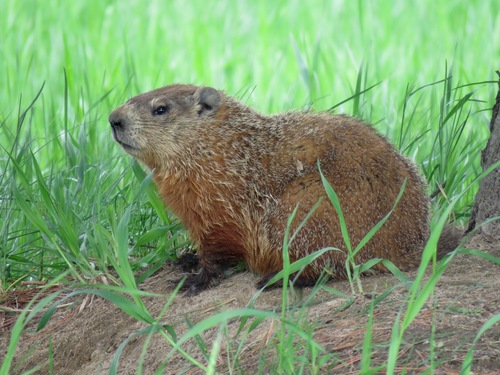
Marmota monax, commonly called the groundhog or woodchuck, is the largest sciurid in most of its geographical range. The only exception is in British Columbia, where its size is comparable to its somewhat larger close relative, the hoary marmot. Adult groundhogs have a total length ranging from 41.8 to 68.5 cm (16+7⁄16 to 26+15⁄16 inches), which includes a tail that measures between 9.5 and 18.7 cm (3+3⁄4 to 7+3⁄8 inches). Adult weights typically fall between 2 and 6.3 kg (4 lb 7 oz to 13 lb 14 oz). On average, males are slightly larger than females. Like all marmots, they are much heavier in autumn, during their seasonal period of autumn hyperphagia, than they are when they emerge from hibernation in spring. Year-round, adult males have an average weight of 3.83 kg (8 lb 7 oz), with an average weight range of 3.1 to 5.07 kg (6 lb 13 oz to 11 lb 3 oz) from spring to fall. Adult females have a year-round average weight of 3.53 kg (7 lb 13 oz), with a spring to fall average weight range of 3.08 to 4.8 kg (6 lb 13 oz to 10 lb 9 oz). Seasonal weight changes correspond to the yearly cycle of depositing and using body fat. Groundhogs gain increasingly more weight each year for their first two to three years of life, after which their weight stops increasing and plateaus. Groundhogs have four incisors that grow 1.5 millimetres (1⁄16 inch) per week, and constant use of these teeth wears them down by about this same amount each week. Unlike the incisors of many other rodents, groundhog incisors are white to ivory-white. Groundhogs are well adapted for digging, with powerful short legs and broad long claws. Their tail is shorter than the tails of other members of the Sciuridae family, making up only about one-quarter of their total body length. Unlike other marmot species that occupy rocky, mountainous areas, the groundhog lives in lowland habitats. It has a wide geographic range, and prefers open country and woodland edges. It is rarely found far from the entrance of one of its burrows. Common habitats for groundhogs include small woodlots, low-elevation forests, fields, pastures, and hedgerows. They build their dens in well-drained soil, and most individuals maintain separate summer and winter dens. Increased food access and abundance from human activity has allowed Marmota monax populations to thrive. Among all marmot species, groundhogs are the most solitary. They do live in aggregations, and their social organization varies between different populations. Groundhogs do not form stable, long-term pair bonds, and interactions between males and females during mating season are normally limited only to copulation. However, groundhogs living in Ohio have been observed to have a different social organization than populations elsewhere; in Ohio, adult males and females associate with one another throughout the year, and often across multiple years. Most groundhogs first breed during their second year of life, though a small portion may breed in their first year. Their breeding season runs from early March to mid- or late April, immediately after hibernation ends. Woodchucks are generally described as polygynous, but only female alpine marmots and female woodchucks have been documented mating with multiple males. During the 31- to 32-day gestation period, a mated pair shares the same den. As the April or May birth of the litter approaches, the male leaves the den. Females produce one litter each year. Litters contain between one and nine offspring, and most litters have 3 to 5 pups. Once the pups have grown a full coat of fur and gained the ability to see, the mother introduces them to the outside wild. At this point, if the father returns to the family group at all, he will do so now. By the end of August, the family group breaks up, and most young groundhogs scatter to dig their own independent burrows.