About Marmota flaviventris (Audubon & Bachman, 1841)
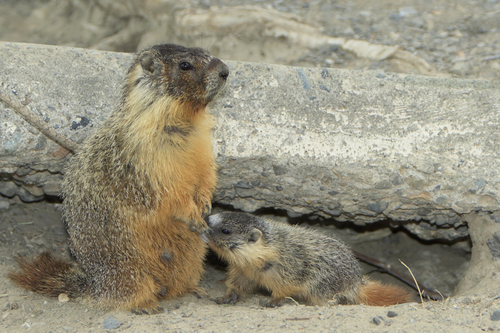
Fully grown yellow-bellied marmots usually weigh between 1.6 and 5.2 kg (3 lb 8 oz to 11 lb 7 oz), with males typically heavier than females. Their weight fluctuates dramatically throughout the year: it is lowest in early spring and highest in early autumn. Adult males usually weigh 3–5 kg (7–11 lb), while adult females typically weigh 1.6–4 kg (3+1⁄2–9 lb). They have a total body length of 47–68 cm (18+1⁄2–27 in), with a short 13–21 cm (5–8+1⁄2 in) tail covered in buffy, reddish, and black hairs. Their hindfeet measure 7–9 cm (3–3+1⁄2 in), and their small round ears measure 1.8–2.2 cm (11⁄16–7⁄8 in) in length. Yellow-bellied marmots have a generally frosty appearance; many of their guard hairs have pale tips and dark bands. They have a broad, flat skull, a dark head, and a dark nose with a white furry patch. Their fur (pelage) is made up of coarse, long outer hairs and a shorter, woolly underfur. Their main coat is brown, with a white patch of fur on the snout in front of the eyes. They get both their common and scientific names from the bright yellow fur covering their belly, the sides of their neck, and their throat. They have a short white muzzle. Their back is reddish-brown, with a grizzled mix of black and light-grey tan, and their feet range in color from yellowish to dark brown. In autumn, they build up extra fat reserves to prepare for hibernation. Their average lifespan is 15 years, which is relatively long for their body size. This longer lifespan is common among hibernating species, as hibernation has been shown to slow the process of epigenetic ageing. Yellow-bellied marmots are native to southwestern Canada and the western United States, including the Rocky Mountains and the Sierra Nevada. Their range extends north into southern British Columbia, east into the montane and basin regions of Wyoming, eastern Montana, Colorado, and southern Alberta, and south into northern New Mexico. They live in steppes, meadows, talus fields, and other open habitats, and sometimes occur on the edges of deciduous or coniferous forests. In Colorado, they are found at elevations ranging from as low as 1,600 m (5,400 ft) to over 4,300 m (14,000 ft). In central and eastern Washington, they are common at low elevations. They occupy valleys, meadows, and foothills, and tend to live in open areas with little to no vegetation. A marmot territory covers about 2.5 hectares (6 acres), centered around multiple burrows dug over the summer. While marmots will sometimes burrow underneath trees and buildings, they most often dig burrows under rocks, as these locations are less visible to predators. Common predators of yellow-bellied marmots include foxes, dogs, coyotes, wolves, and eagles. When a marmot spots a predator, it whistles to warn other nearby marmots, then typically hides in a nearby rock pile until the threat has passed.