About Marmota caudata (Geoffroy, 1844)
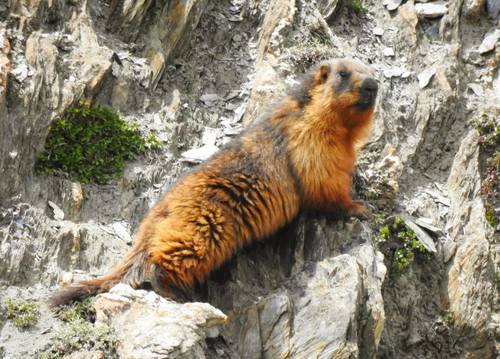
The long-tailed marmot, Marmota caudata, is a large, sturdy rodent. Its maximum weight reaches 9 kg (20 lb), with a typical weight range of 1.5 to 7.3 kg (3.3–16.1 lb). Lower weights occur in spring immediately after hibernation, while higher weights occur in autumn just before hibernation, when more than one quarter of the marmot’s body mass consists of fat. Males average slightly larger than females. Head-and-body length ranges from 37–80 cm (15–31 in), and tail length ranges from 16–28 cm (6.3–11.0 in). The tail makes up 37–55% of the head-and-body length, which is considerably longer than the tail length ratio of most other marmots; the proportionally longest-tailed individuals of grey (M. baibacina) and alpine marmots (M. marmota) are only comparable to the shortest-tailed long-tailed marmots. This species has eyes positioned close to the top of a rather flattened head, small ears, a short neck, and forelegs that are longer than the hind legs. While multiple subspecies of long-tailed marmot have been described, only three are generally recognized: M. c. caudata, M. c. aurea and M. c. dichrous. M. c. dichrous has occasionally been classified as a separate species. The three subspecies differ in fur color and some body measurements, with M. c. caudata averaging larger than the other two. M. c. aurea, the subspecies found across most of the species’ range, has overall relatively bright golden-buff or orange-tawny fur. Its face is brownish, and the top of its head is typically brown to black, though it matches the back color in parts of the subspecies’ range. The tip of the tail is often blackish. M. c. caudata also has a brown face, with yellowish flanks and underparts, black on the rear top of the head and mid-back, and a tail that is black or a mix of yellowish and black. M. c. dichrous has black-brown underparts, and is dimorphic in upper body color: upper parts are blackish-brown to dull brown in dark morphs, and light brown to cream in pale morphs. The long-tailed marmot is found only in Afghanistan, Kyrgyzstan, Tajikistan, far southern Kazakhstan (where it is rare), Uzbekistan, northern Pakistan, northwestern India and western China. In China, it has only been recorded in the Tian Shan Mountains of Xinjiang. Other mountain ranges it inhabits include the Pamir, Alay, Hindukush, Kunlun-Shan, Karakoram and northwestern Himalayas. Its distribution contacts the ranges of Menzbier's (M. menzbieri), grey (M. baibacina) and Himalayan marmots (M. himalayana), but no hybridization between these species is known to occur. Of the three subspecies, M. c. aurea is widespread and present in all countries where the species occurs, and is only absent from regions occupied by the other two subspecies. M. c. caudata is native to areas south of Chitral in Pakistan and adjacent parts of India, while M. c. dichrous lives in highlands near Kabul and Ghazni in Afghanistan. Overall, the long-tailed marmot has a very broad altitude range, occurring from 600 to 5,200 m (2,000–17,100 ft). This range varies extensively between mountain ranges, with the upper altitude limit essentially set by the location of the permanent snow line. Kyrgyzstan and Tajikistan are the only countries where this species has been recorded below 2,000 m (6,600 ft), though it also occurs at much higher altitudes in both countries. It is more tolerant of arid conditions than the closely related Menzbier's marmot and the more distantly related grey marmot. Where their distributions approach each other, the long-tailed marmot tends to occupy drier habitats. Additionally, where its distribution meets that of Menzbier's marmot, the long-tailed marmot occurs at lower altitudes, between 1,300 to 2,200 m (4,300–7,200 ft). It inhabits a wide range of open or lightly wooded habitats, including alpine meadows, foothill to highland steppes, semi-deserts, scrublands and open woodland (typically with junipers no taller than 4 m or 13 ft), and is especially common in rocky areas. It does not occupy areas with saline soils. Long-tailed marmots usually form monogamous pair bonds, but live in larger social groups of up to seven adults that share a single home range. Group members are typically related to one another; young adults usually only disperse after reaching full growth at age three or older. Adult immigrants are tolerated in the group, but only one adult female normally lactates and rears young in a single breeding season. The average long-tailed marmot home range is about three hectares (7.5 acres), and contains about three burrow systems (range 1 to 6). The marmots hibernate in a chamber inside one of these burrows from around September to April or May, a period when the ground is mostly covered by snow. Different burrows may be used for hibernation in different years. Mating takes place in late April and early May, and may occur underground before marmots emerge from the burrow after winter. The gestation period is about four and a half weeks, and a litter of around four pups emerges from the nest at about six weeks of age. Only around half of pups survive the summer; some are eaten by predators, and others are killed by adult males that join the group. Most adults survive the hibernation period, but a considerably higher proportion of juveniles die during their first winter. Females usually do not breed at three years old, and wait until the following year to breed. The long-tailed marmot is diurnal and feeds on plant material. It is most active in the morning, when around 40% of activity is spent foraging. After emerging from the burrow, marmots spread out and do not forage as a group. They collect food from the ground with their mouths, or pluck it from taller plants. Between foraging bouts, marmots sometimes stand on their hind legs to survey their surroundings. Group members communicate with each other, and produce complex alarm calls when predators are spotted. They also respond to alarm calls from neighbouring groups.