About Marmota caligata (Eschscholtz, 1829)
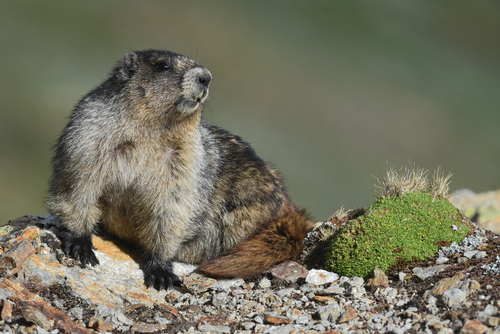
The hoary marmot, Marmota caligata (Eschscholtz, 1829), is a large, bulky ground squirrel with short heavy limbs and a broad head. For adults, total length ranges from 62 to 82 cm (24 to 32 in), which includes a tail measuring 17 to 25 cm (6.7 to 9.8 in). This species is sexually dimorphic, with males significantly larger than females in most subspecies. Because hoary marmots hibernate through the winter, surviving on stored fat reserves, their weight changes dramatically over the course of a year. Fully grown adults average 3.75 kg (8.3 lb) in May, and reach around 7 kg (15 lb) by September. A number of adult males commonly reach up to 10 kg (22 lb) in the fall. The largest recorded autumn male specimen had a mass of nearly 13.5 kg (30 lb), which is possibly the largest size recorded for any marmot. Compared to other marmot species, the hoary marmot averages slightly smaller than the Olympic marmot, is similar in size to the Vancouver Island marmot, and overlaps broadly in size with several lesser-known Asian marmot species. Its common name 'hoary' refers to the silver-gray fur covering its shoulders and upper back. The rest of its upper body has drab or reddish-brown fur. The top of its head is black, with a white patch on the muzzle, white fur on the chin and around the lips, and grizzled black or brown fur on other areas of the head. The feet and lower legs are black, and sometimes have white patches on the fore feet. Marmots have long guard hairs that create most of their coat's visible color, plus a dense, soft underfur that provides insulation. The greyish underparts of the body do not have this underfur, and are sparser in fur than the rest of the body. Hoary marmots moult from early to mid summer. Their feet have slightly curved claws that are larger on the fore feet than the hind feet, with hairless pads that improve grip. Their tail is long, slightly flattened, and covered in dense fur. Apart from males being larger, both sexes look very similar. Females have five pairs of teats, stretching from the pectoral to inguinal regions. Hoary marmots primarily live in mountainous alpine environments up to 2,500 metres (8,200 ft) in elevation, though coastal populations also live at or near sea level in British Columbia and Alaska. Their range extends north from southern Washington and central Idaho, and covers most of Alaska south of the Yukon River. They live above the tree line, at elevations from sea level to 2,500 metres (8,200 ft) that vary with latitude, in rocky terrain or alpine meadows dominated by grasses, sedges, and herbs, alongside Krummholz forest patches. Range maps often incorrectly show hoary marmots living north of the Yukon River in Alaska; this region is instead occupied by the Alaska marmot (M. broweri). Hoary marmots can also be found on several Alaskan islands, and Pleistocene fossils of the species have been found on islands that are no longer inhabited by hoary marmots. Three subspecies are currently recognized: Marmota caligata caligata found in Alaska, Yukon, the Northwest Territories, and northern British Columbia; Marmota caligata cascandensis found in the Cascade Mountains from British Columbia to Washington; and Marmota caligata okanagana found in the Rocky Mountains from Yukon to Montana and Idaho. Hoary marmots breed shortly after, or even before, they emerge from their hibernation burrows in May; in some areas such as the eastern Cascade foothills of Washington State, breeding can occur as early as February. Courtship involves sniffing the genital region, followed by mounting, and mounting has also been observed between female hoary marmots. Females typically only produce litters every other year, though occasional higher and lower breeding frequencies have been recorded. Gestation lasts 25 to 30 days, so litters of two to five young are born between late May and mid-June. The young leave their birth den when they are three to four weeks old. By this age, they already have a full coat of fur and are starting to be weaned. Young hoary marmots are initially cautious, but develop the full range of nonreproductive adult behaviors within about four weeks of emerging from the burrow. Subadults initially stay with their birth colony, but typically leave at two years of age, and become fully sexually mature the following year.