About Marmota bobak (Müller, 1776)
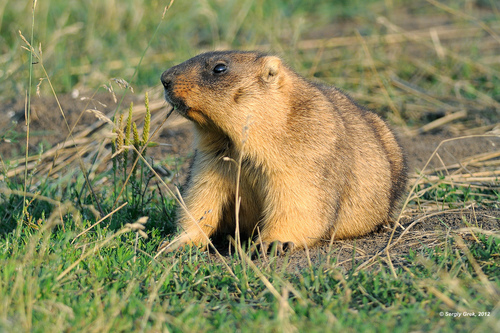
The bobak marmot, scientifically named Marmota bobak (Müller, 1776), is also commonly called the steppe marmot. It is a social species of marmot that lives in the steppes of Eastern Europe and Central Asia, specifically occupying steppe grasslands including the borders of cultivated fields. This species hibernates for more than half of each year, staying active for only around five and a half months annually. On average, litters contain about five offspring. Young marmots take three years to reach sexual maturity. Male offspring leave their home colony after their second winter hibernation, and roughly 60% of mature females produce offspring in any given year. The bobak marmot is native to the steppes of Eastern Europe and Central Asia. Its current range extends from central and eastern Ukraine, through far southwestern Russia, to northern and central Kazakhstan. Historically, the species had a continuous range, but it has been extirpated from several areas including its former range in southeastern Belarus and eastern Hungary, leaving its overall current range discontinuous. It has been reintroduced to some locations, and its range is slowly expanding again. In the highlands of Kazakhstan, the bobak marmot comes into contact with the gray marmot, and animals in this contact zone typically show intermediate physical features. In 2019, scientists Alyona Koshkina, Johannes Kamp, and other researchers used satellite imagery to map 7,000 bobak marmot burrows across Kazakhstan's steppes; these burrows host an estimated population of approximately six million marmots. The bobak marmot is often described as a large ecological analog of the North American prairie dog. It has a rounded abdomen, stubby legs, and a short tail. It lives in steppe ecosystems and thrives on rolling grasslands and at the edges of cultivated fields. Dispersing individuals leave their natal social group after their second hibernation. This species only has a single type of alarm call, but studies show that bobak marmots produce this call faster when they occupy steep terrain, and slower when they live on flatter terrain. The fur of the bobak marmot is used to make hats and occasional coats. A fur farm outside Moscow is currently experimenting with captive breeding of bobak marmots to produce fur for commercial use. Like other marmot species, the bobak marmot is susceptible to infection with bubonic plague. A population of bobak marmots in the Ural Mountains is thought to have acted as a reservoir host for the bubonic plague epidemic that affected western Russia in the late 19th century. Snow leopards prey on bobak marmots, and the species can also act as a buffer prey for snow leopards when other prey is unavailable.