About Marmaronetta angustirostris (Ménétries, 1832)
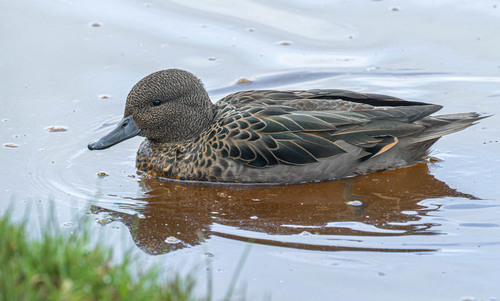
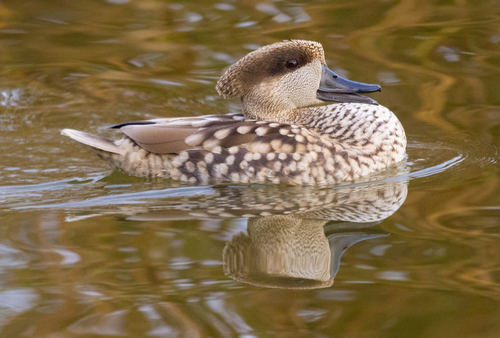
Description and diet: The marbled duck, also called marbled teal, measures approximately 39–42 cm (15–17 in) in length. Adult marbled ducks are pale sandy-brown, with diffuse off-white blotches across their bodies, a dark eye patch, and a shaggy head. Females are on average smaller than males, but the sexes look otherwise identical. Juvenile marbled ducks resemble adults, but have more off-white blotches. When in flight, their wings appear pale with no distinct marking, and there is no speculum on the secondary feathers. Marbled ducks feed primarily in shallow water, by dabbling or up-ending. Adult diets are mostly made up of seeds, for example seeds from Scirpus and Ruppia, but they also consume significant amounts of invertebrates—especially aquatic insect larvae and pupae, tiny crustaceans, and ants, which is highly unusual for a duck—and green plants such as Potamogeton. Their gizzard lets them break down seeds, and the lamellae on their beak allow them to filter feed on zooplankton. Young marbled ducks eat mostly invertebrates. While they may consume tiny seeds, they do not have the large gizzard needed to break down the larger seeds that adults commonly eat. Distribution, habitat and breeding: This duck once bred in large numbers across the Mediterranean region, but it is now restricted to just a few sites in southern Spain, southern Italy, northwest Africa, and the broader Levant. Further east, the species survives in the Mesopotamian marshland of southern Iraq and in Iran, where Shadegan Marshes is the world's most important site for the species, as well as in isolated pockets in Armenia, Azerbaijan, South European Russia, western India, and western China. Overall, the species has nomadic tendencies. In some regions, birds leave their breeding grounds to disperse, and individuals have been found wintering in the Sahel zone, south of the Sahara. The species' preferred breeding habitat is temporary, shallow fresh, brackish, or alkaline water with densely vegetated shores, located in otherwise fairly dry regions. It may also breed in coastal lagoons, along slow-moving rivers, or in human-made water bodies such as reservoirs. On average, clutches contain around 12 eggs, which are laid in a nest hidden by dense vegetation at the water's edge. The nest is usually built on the ground, but occasionally it is placed higher up among reeds or on reed-made huts. Marbled ducks are common in captive collections, but they are naturally nervous and flighty birds. They are gregarious, and will sometimes gather even during the nesting season. Flocks are often small outside of the breeding season, though large wintering flocks have been recorded in some areas. The largest known winter concentration of marbled ducks is in Khuzestan, Iran. In 2011, a group of Iraqi ornithologists counted a single flock of the rare marbled teal on the lakes of the Iraqi marshes that numbered at least 40,000 birds.