About Margarornis squamiger (Orbigny & Lafresnaye, 1838)
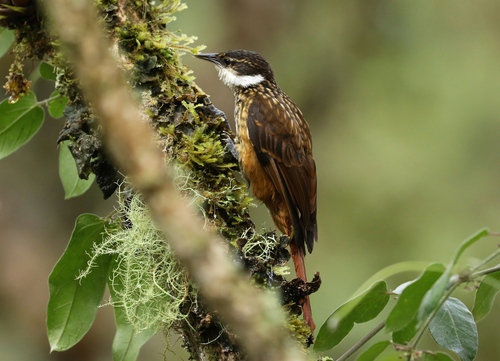
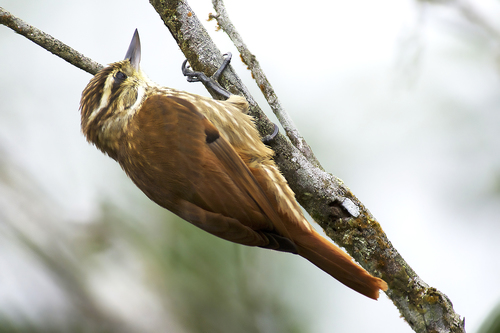
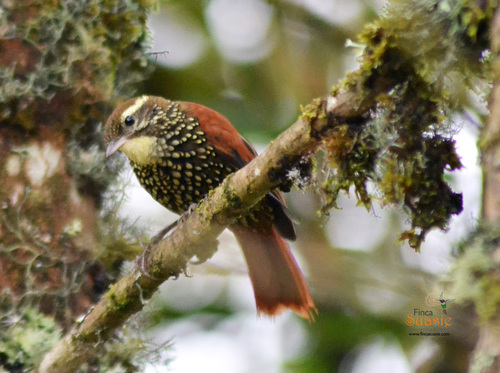
The pearled treerunner, Margarornis squamiger, measures 15 to 16 cm (5.9 to 6.3 in) long and weighs 14 to 19 g (0.49 to 0.67 oz). Males and females have identical plumage. Nominate subspecies adults have a distinct yellowish buff supercilium that reaches the nape, a dull reddish brown line behind the eye, a mix of dull yellowish buff and dark brown ear coverts, and a dark brown moustachial area marked with tiny whitish spots that turn into streaks toward the back. Their forehead is dark brownish with pale rufous streaks, and their crown is dark reddish brown. Their collar is dull rufescent brown with yellowish buff streaks outlined in black. Their back, rump, and uppertail coverts are bright reddish brown. Their wing coverts are bright reddish brown, primary coverts dark fuscous brown, and flight feathers a darker fuscous brown with rufescent edges. Their tail is bright reddish brown, and the tips of the tail feathers lack barbs, creating a spiny appearance. Their throat is bright buff-yellow. Their breast and belly have a rufescent base color. The upper breast is densely covered in oval yellowish spots with dark brown outlines; the spots become elongated and less distinct on the lower breast, and continue onto the belly. Their flanks are a darker rufescent shade than the belly, with longer spots, and their undertail coverts are rufescent brown with a small number of black-outlined buff-yellowish streaks. Their iris ranges from brown to dark brown, their maxilla from black to gray, their mandible from whitish horn to purplish pink, sometimes with a dark tip, and their legs and feet from brownish gray to dark brown. Juveniles have dusky tips on their throat feathers and a less regular spot pattern on their breast than adults. Subspecies M. s. peruvianus differs noticeably from the nominate. It has a paler yellow supercilium, less rufous color and heavier streaking on ear coverts, an olive-brown crown, and far less spotting on the underparts. M. s. perlatus is similar to peruvianus, but has a whitish supercilium and whiter spotting on the underparts. The subspecies of the pearled treerunner have the following distributions: M. s. perlatus occurs from western Venezuela's Serranía del Perijá and Andes, south through all three of Colombia's Andean ranges and the Andes of Ecuador, into the northern Peruvian departments of Piura and Cajamarca. M. s. peruvianus occurs in the Andes of Peru south of the Marañón River, from the departments of Cajamarca and Amazonas south to the Department of Cuzco. M. s. squamiger occurs in the Andes from southern Peru's Department of Puno, south into Bolivia as far as Santa Cruz Department. There is a single confirmed sight record of the species in northern Argentina's Salta Province, so the South American Classification Committee of the American Ornithological Society lists the species as hypothetical in Argentina. The pearled treerunner mainly lives in montane evergreen forest and elfin forest, and also occurs locally in Polylepis woodland and secondary forest. It prefers forest stands thick with moss and epiphytes. Its elevation range mostly falls between 2,500 and 3,500 m (8,200 and 11,500 ft), but it has been recorded as low as 1,500 m (4,900 ft) and as high as 3,800 m (12,500 ft).