About Margarops fuscatus (Vieillot, 1808)
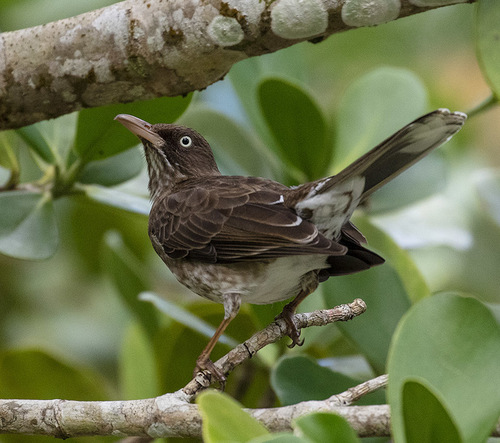
The pearly-eyed thrasher, scientific name Margarops fuscatus (Vieillot, 1808), is the largest species in the Mimidae family, reaching a length of 28 to 30 cm (11 to 11.8 inches).
This bird has a somewhat disjunct distribution across the West Indies. It can be found in the Bahamas, Puerto Rico (including both the main island and Mona Island), the Virgin Islands, the Turks and Caicos islands, Dominican Republic’s Isla Beata, Bonaire, and most of the Lesser Antilles. It has been extirpated from Barbados and Grenada. Within the Bahamas, pearly-eyed thrashers breed on San Salvador, Exuma, and Long Island, and are thought to also breed on Acklins, Mayaguana, and Great Inagua; they occur as wintering birds on Eleuthra and Cat Island. Within the Lesser Antilles, they breed in the SSS islands (the northern part of the Netherlands Antilles), Barbuda, Antigua, Montserrat, Guadeloupe, Dominica, Martinique, St. Lucia, St. Thomas, and St. Vincent and the Grenadines. The subspecies M. f. bonairensis was formerly recorded on La Horquilla, one of the Hermanos Islands off the north coast of Venezuela, but it is now believed to be extirpated from this location; the last reported sighting of this subspecies there was in 1908. Its primary habitat consists of bushes and trees in mountain forests and coffee plantations.
Pearly-eyed thrashers are aggressive, opportunistic omnivores. They feed primarily on large insects, but also consume fruits and berries, and will occasionally eat lizards, frogs, small crabs, and other birds’ eggs and nestlings. This species nests in cavities. In Puerto Rico, it competes with the critically endangered Puerto Rican amazon (Amazona vittata) for nesting sites, and may even destroy the parrot’s eggs.