About Margaritifera margaritifera (Linnaeus, 1758)
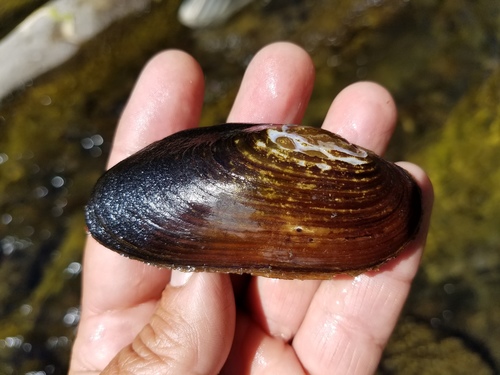
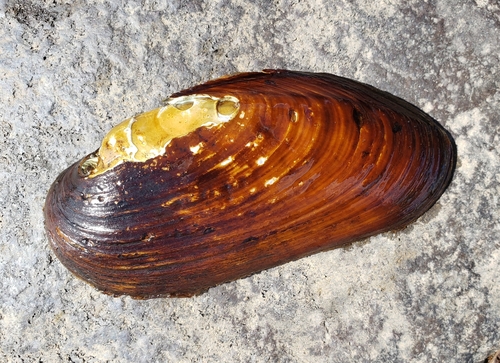
Margaritifera margaritifera, commonly known as the freshwater pearl mussel, is one of the longest-living invertebrates alive today. The oldest known European specimen was caught in Estonia in 1993, and was aged 134 years old. Like all bivalve molluscs, it has a two-part hinged shell that can close to protect its soft inner body. Its shell is large, heavy and elongated; young individuals typically have yellowish-brown shells that darken as the mussel ages. A key identifying feature of this species is that older sections of the shell often appear corroded. The inner surface of the shell is pearl white, sometimes with an attractive tint of iridescent colours. Like all molluscs, the freshwater pearl mussel has a muscular foot. This species has a very large, white foot that lets it move slowly and bury itself into the bottom substrate of its freshwater habitat. This species has a native Holarctic distribution, found on both sides of the Atlantic, ranging from Arctic and temperate regions of western Russia, through Europe, to northeastern North America. In North America, it occurs in eastern Canada and New England in the United States' Northeast. In Europe, it is found across multiple regions: In Austria, an estimated total population of 70,000 individuals occurs in Mühlviertel (Upper Austria, where the population is declining) and Waldviertel (Lower Austria, where some recruitment occurs). It is present in Belgium. In the Czech Republic, it is classified as critically endangered. It is probably still present in Bohemia and locally extinct in Moravia. It is listed as a Critically Threatened species in Czech Decree No. 395/1992 Sb., as amended by 175/2006 Sb. A 2004–2006 report for the European Commission prepared under the Habitats Directive assessed its conservation status as bad (U2). In Serbia, it is most commonly found along the shores of the Danube river, Danube lakes, and some other rivers and freshwater areas in the Pannonian Basin. In Denmark, it is only known from the Varde River, and has never been recorded anywhere else in the country in historical or recent times. While some sources suggested it was extirpated shortly after 1970, it has been documented in the river in recent years, and indirect evidence points to a significant population size. It occurs in Estonia. In Fennoscandia, it is assessed as vulnerable in Norway, endangered in Finland and Sweden. It is very rare in southern Finland and more common in northern Finland. It is widespread but not common in Norway, and Norway hosts a large proportion of the European population of the species. It is rare in Sweden. It also occurs on Russia's Kola Peninsula and in Karelia. It is present in France. In Germany, it is classified as critically endangered (vom Aussterben bedroht), and is listed as a strictly protected species in annex 1 of the Bundesartenschutzverordnung. It occurs in Great Britain. More than half of the world's recruiting population of this species is found in Scotland, where it occurs in over 50 rivers, mainly in the Highlands. However, illegal harvesting has seriously harmed the species' survival. 75% of surveyed sites in 2010 had suffered "significant and lasting criminal damage", and police and Scottish Natural Heritage have launched a protection campaign in response. This species has been fully protected in the United Kingdom under the Wildlife and Countryside Act 1981 since 1998, and had partial protection under section 9(1) starting in 1991. It occurs on the Iberian Peninsula (Portugal and Spain). It occurs in Ireland. The Cladagh (Swanlinbar) river holds one of the largest surviving populations in northern Ireland, with an estimated minimum population of 10,000 individuals confined to a 6 km stretch of undisturbed river in the river's middle section. It is present in Luxembourg, Latvia, and Lithuania, where it is extinct. It is extinct in Poland. In the Russian Federation, it lives in rivers of the White Sea basin in the Arkhangelsk and Murmansk Regions, which forms the eastern border of Margaritifera margaritifera's distribution range. The freshwater pearl mussel requires clean, fast-flowing streams and rivers, where it lives buried or partly buried in fine gravel and coarse sand. It is generally found in water between 0.5 and 2 metres deep, but sometimes occurs at greater depths. Clean gravel and sand is essential, especially for juvenile freshwater pearl mussels; if the stream or river bottom becomes clogged with silt, juveniles cannot get oxygen and will die. The species also requires a healthy population of salmonids (a group of fish that includes salmon and trout), as it depends on these fish for part of its life cycle.