About Margaritifera falcata (A.Gould, 1850)
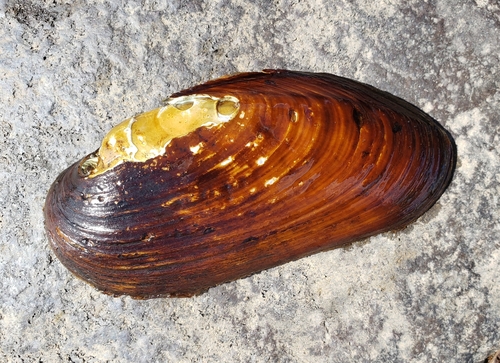
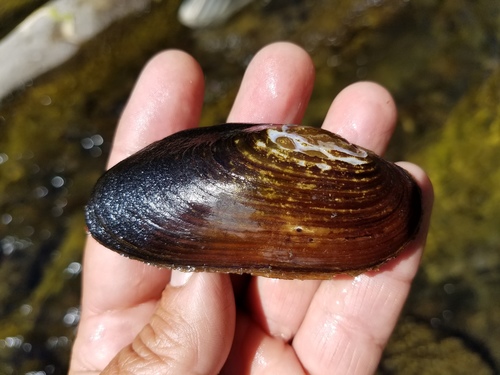
The western pearlshell, Margaritifera falcata, is a species of freshwater bivalve pearl mussel, a bivalve mollusk belonging to the family Margaritiferidae. This species is found exclusively in the United States and Canada, and most of its range occurs west of the Rocky Mountains. Specifically, this pearl mussel lives in Pacific drainages stretching from northern California up through British Columbia to southern Alaska. A number of the species' coastal and large river populations are considered by some scientists to be already extirpated, nearly extirpated, or rapidly declining. Despite these population losses, the species remains common across parts of the northern Rocky Mountains, though some populations in Montana are thought to be declining. M. falcata also occurs east of the Continental Divide, in the headwaters of the Missouri River. Originally, these eastern populations were classified as the eastern pearl mussel species Margaritifera margaritifera, but recent scientific work has confirmed these populations are actually M. falcata. This confirms that the species successfully crossed the Continental Divide. The most widely accepted explanation for this cross-continental divide distribution is headwater capture, a process where glacial advance or retreat reshapes and reconfigures pre-glacial watersheds. During the Pleistocene glaciation, more than 20,000 years ago, westslope cutthroat trout crossed the Continental Divide from the west into the headwaters of what is now the Missouri River. Since cutthroat trout are an important host species for the glochidia larvae of M. falcata, it is likely that the mussels crossed the divide by attaching to and traveling with these trout.