About Margarites pupillus (Gould, 1849)
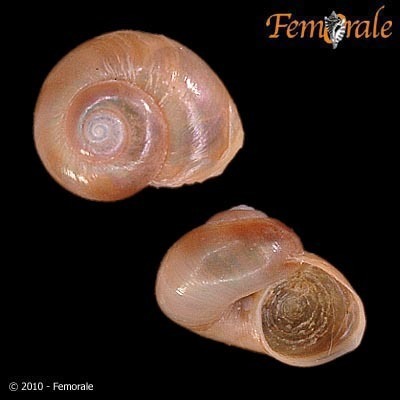
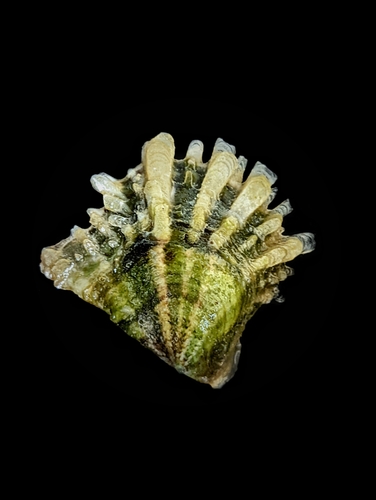
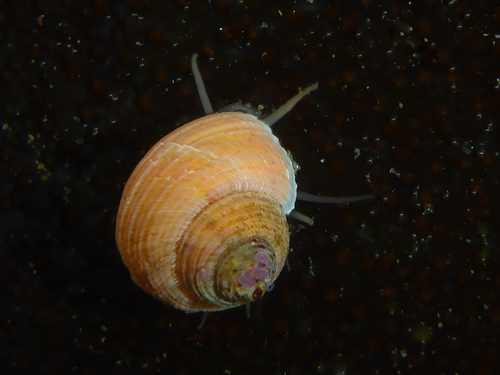
Margarites pupillus, first described by Gould in 1849, has a shell that ranges in size from 8 mm to 20 mm. This solid shell is conical in shape, narrowly umbilicated, lusterless, and colored ashen or whitish. The species is highly variable: shells found further south develop a deeper salmon hue and have finer surface sculpture. The shell surface is crossed spirally by uneven cord-like lirae, separated by sharply crispate-striate interspaces that are as wide as or wider than the ridges. The ridges themselves are nearly smooth, or show faint traces of oblique striation. A spiral thread usually sits in the inter-liral spaces on the final 1½ whorls; above this section, each whorl has 4 or 5 lirae. On the shell's base, around 12 concentric riblets decrease regularly in size from the center outward. The spire is elevated, the apex is subacute, and the sutures are impressed. The shell has 6 convex whorls; the final whorl is obtusely angled and flattened beneath. The aperture is very oblique, rounded, and iridescent on the inside. The peristome is simple. The columella is arcuate and subreflexed at the umbilicus, often nearly closing the umbilicus, and connects to the upper end of the lip via a parietal callus. The funnel-shaped umbilicus is bounded by a carina, and its perforation is very small. This marine species is distributed from the Bering Sea to Southern California, USA, and occurs from the low intertidal zone down to 100 meters depth. In the San Juan Islands, Washington, USA, the subtidal population density of Margarites pupillus is tied to the abundance of the kelp Agarum fimbriatum. Densities can reach over 400 snails per square meter in areas with 100% bottom cover from kelp, while density drops to only a few snails per square meter below the algal zone. This snail is a generalist grazer. Analysis of gut contents from examined snails found that all individuals contained unidentifiable detritus plus silt and sand; 94% contained unidentified filamentous red algae, 86% contained diatoms, 79% contained sponge spicules, 64% contained filamentous brown algae, 21% contained hydroid remains, 14% contained bryozoan remains, and 7% contained filamentous green algae. No evidence was found that M. pupillus feeds on the Agarum it inhabits. In laboratory experiments, the crabs Cancer productus and Cancer oregonensis, and the seastar Leptasterias hexactis readily preyed on M. pupillus. Other potential predators that did not prey on M. pupillus during lab trials include the gastropods Fusitriton oregonensis, Ceratostoma foliatum, Searlesia dira, and Amphissa columbiana, and the seastars Pycnopodia helianthoides, Pisaster ochraceus, Evasterias troschelii, Solaster stimpsoni, and Dermasterias imbricata, though S. dira has been reported to prey on these snails. M. pupillus shows predator-specific anti-predator behavioral responses. After physical contact with seastars such as L. hexactis, E. troschelii, and P. ochraceus, it exhibits a rapid flight response: it increases its movement rate to up to 9.5 cm per minute, accompanied by shell twisting. The predatory snail F. oregonensis also elicits this rapid flight response, even though F. oregonensis did not consume M. pupillus in laboratory experiments. When M. pupillus contacts a predatory crab such as C. oregonensis, however, it rapidly withdraws into its shell and relies entirely on physical defense. In the San Juan Islands, Washington, USA, Margarites pupillus lives among kelp beds of the large brown kelp A. fimbriatum. These snails are typically found on the upper surfaces of kelp, rather than on the seabed beneath the kelp. Evidence indicates that kelp provides a refuge for these snails, separating them from benthic predators, especially crabs. Gut analysis of local crab-eating fishes, including kelp greenling and cabezon sculpin, found that 85% of analyzed fish guts contained remains of crabs (including species known to prey on M. pupillus), while only 2% contained M. pupillus operculi. These results suggest that crabs likely avoid the upper surfaces of kelp, where they would be more exposed to fish predation, making these kelp surfaces safer habitats for M. pupillus.