About Mareca americana (J.F.Gmelin, 1789)
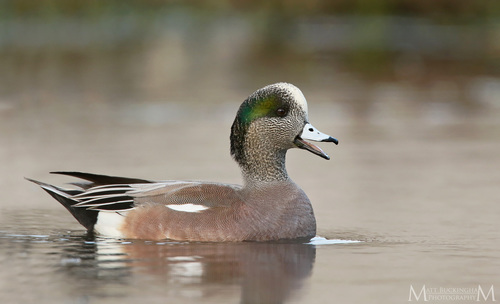
The American wigeon (scientific name Mareca americana) is a medium-sized dabbling duck. It is larger than a teal and smaller than a pintail, and can be told apart from other dabbling ducks by its distinctive silhouette: a round head, short neck, and small bill. It measures 42–59 cm (17–23 in) in length, has a 76–91 cm (30–36 in) wingspan, and weighs 512–1,330 g (1.129–2.932 lb). Adult American wigeons go through two molts each year, and juveniles undergo an additional molt during their first year. Breeding males (drakes) are very distinctive: they have a green feathered mask around the eyes, a cream-colored cap stretching from the crown of the head to the bill, a white belly, and a large white shoulder patch on each wing that is visible in flight. This white cap gives the species its alternative common name, baldpate, as "pate" is another term for head. Drakes molt into nonbreeding (eclipse) plumage that looks much more similar to female plumage. Females (hens) have primarily subtle gray and brown plumage that is far less conspicuous. Both sexes share the same identifying traits: a pale blue bill with a black tip, a white belly, and gray legs and feet. The wing patch behind the speculum is gray. American wigeon can be distinguished from most ducks other than Eurasian wigeon by body shape; Eurasian wigeon differs by having a darker head and an entirely gray underwing, and female American wigeon also have different head and neck coloring than female Eurasian wigeon. The female American wigeon builds her nest on the ground, near water and under protective cover, and lays 6 to 12 creamy white eggs. Flocks of American wigeon often include American coots. American wigeon is a noisy species, and can often be identified in the field by its distinctive calls. Drakes produce a three-note, wheezy whistle that sounds like whoee-whoe-whoe, while females emit hoarse grunts and quacks that sound like a low growl qua-ack. This species is common and widespread, with a conservation status of Least Concern. It breeds across almost all of Canada and Alaska, excluding the extreme north, as well as in the Interior West of the United States through Idaho, Colorado, the Dakotas, Minnesota, eastern Washington, and eastern Oregon. The majority of the population breeds on wetlands in the Boreal Forest and subarctic river deltas of Canada and Alaska. While American wigeon are found in all North American flyways, they are most abundant in the Pacific Flyway. Key wintering areas in this flyway include California's Central Valley and Washington's Puget Sound. Further east, large numbers of wintering American wigeon are supported by the Texas Panhandle, the Gulf Coast of Louisiana and Texas, and the Caribbean. This migratory dabbling duck winters farther south than its breeding range, across the southern half of the United States, Idaho, Washington, Oregon, the Mid-Atlantic coastal region, and extending south into Central America, the Caribbean, and northwestern South America. It is a rare but regular vagrant to western Europe, and has been seen in significant numbers in Great Britain and Ireland since at least 1958; in the United Kingdom, it is most commonly observed in autumn and winter. In 2009, an estimated 2.5 million breeding American wigeon were counted in the traditional survey area, which is just below the 1955–2009 average. In recent decades, American wigeon populations have declined in Canada's Prairie Pothole Region and increased in interior and west coastal Alaska. In the United States, American wigeon is often the fifth most commonly harvested duck, after mallard, green-winged teal, gadwall, and wood duck.