About Marchantia quadrata Scop.
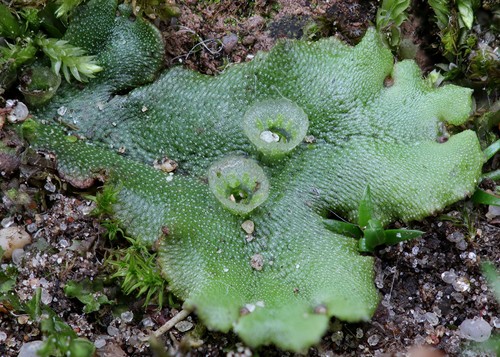
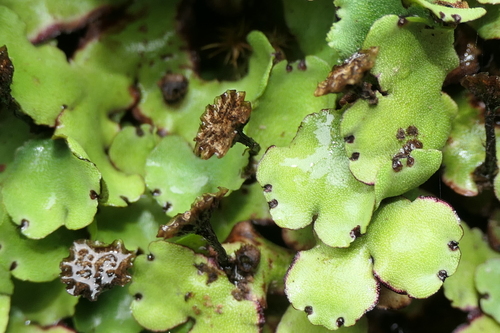
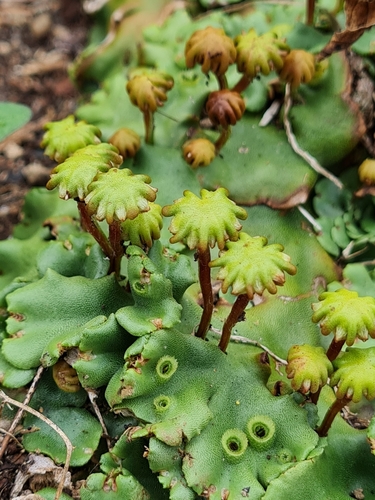
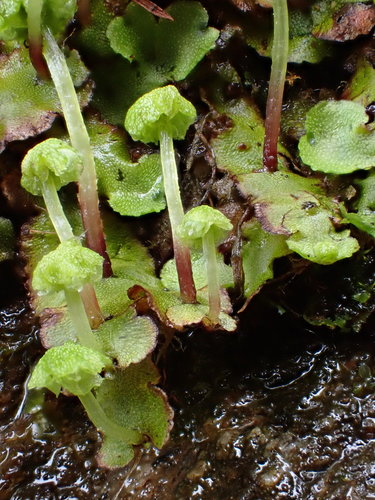
The adult thallus of Marchantia quadrata is defined by its considerable thickness, reaching up to 35 cell layers deep when chlorophyllose cells in air chambers are excluded. It does not have a distinct midrib, which sets it apart from some related species. The thallus is pale green with somewhat wavy margins. When young, it branches dichotomously, and later it forms apical innovations. Two longitudinal rows of purple scales sit along the median line on the thallus’s ventral surface, which also bears both smooth and pegged rhizoids. Specialised sclerotic cells in the ventral region of the thallus act as conducting tissue, though these cells differ from true tracheids in both shape and function. These sclerotic cells are elongated, thick-walled, dark brown, fibre-like cells with pointed ends. They usually occur singly, but occasionally two or three can be found grouped together. Their main function is thought to be water conduction and storage, as they do not appear in plants grown in moist conditions. Growth proceeds from a single cuneate apical cell that produces new segments from its four sides. The species has substantial regenerative ability; it easily grows adventitious structures from its ventral cells when conditions are suitable. This regenerative growth is especially noticeable when plants are kept in greenhouse conditions at the end of the growing season, but fruiting plants with archegonial heads usually do not continue development during this period. Marchantia quadrata is usually dioecious, meaning male and female reproductive structures grow on separate individual plants. Rarely, around 1% of plants, monoecious individuals occur. Both male and female reproductive structures grow on stalked receptacles, and bisexual receptacles are relatively common. Male receptacles typically hold 36–40 antheridia, while female receptacles bear 12–16 archegonia, which are usually distributed as three to four per quadrant, though up to six have been recorded in a single quadrant. Reproductive development follows clear seasonal patterns. Male receptacles are most common early in the growing season, while female receptacles are most abundant later in the season. Bisexual receptacles reach their highest frequency during mid-season. On bisexual receptacles, antheridial development always occurs before archegonial formation.