About Marchantia polymorpha L.
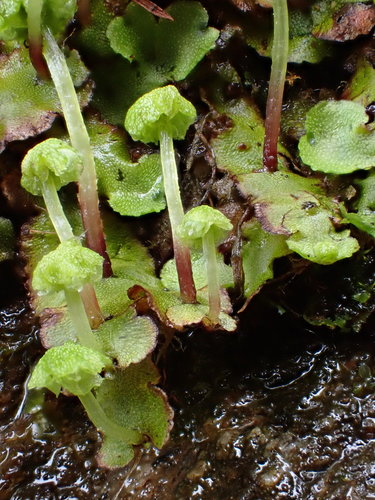
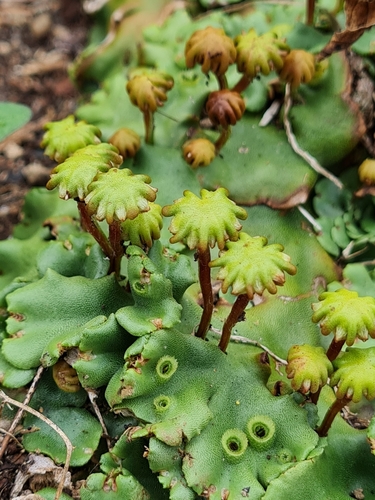
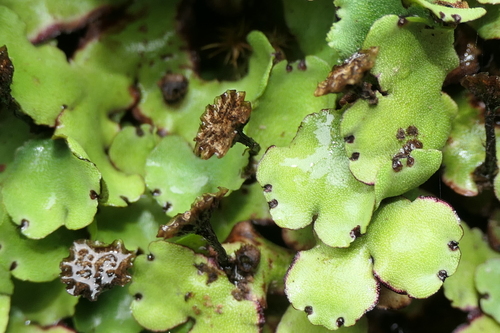
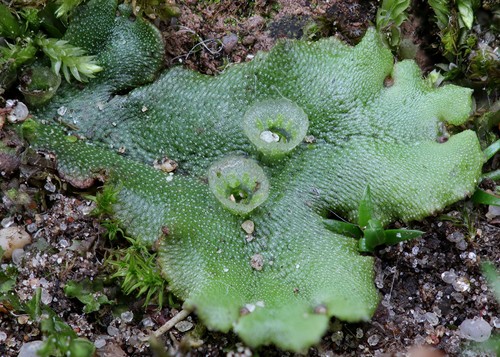
Marchantia polymorpha L. is a thallose liverwort that forms rosettes of flattened, forked-branched thalli. Its thalli reach up to 10cm in length and up to 2cm in width. It is typically green, though older individuals may turn brown or purplish. The upper surface of the thallus features a pattern of polygonal markings, while the underside is covered in many root-like rhizoids that anchor the plant to soil. Like all species in Marchantiopsida, Marchantia polymorpha has complex oil bodies that are restricted to specialized cells, where they fill almost the entire intracellular space. Marchantia polymorpha subsp. ruderalis has a circumpolar boreo-arctic cosmopolitan distribution, occurring worldwide on all continents except Antarctica. The species grows on shaded moist soil and rocks in damp habitats, including stream and pool banks, bogs, fens, and dune slacks. While most varieties grow on moist substrates, Marchantia polymorpha var. aquatica is semi-aquatic, and often invades marshes and small ponds without a consistent water table. This species frequently grows in human-created habitats such as gardens, paths, and greenhouses, and can become a horticultural weed. One common route of spread is through the production and sale of plant liners. Infested liners, which often carry M. polymorpha alongside silvery thread moss, are typically grown in one region, transported to another for further growth, and shipped to retail locations before planting. M. polymorpha can be picked up or dispersed at every step of this transfer process. M. polymorpha is capable of growing under artificial light in locations that have no natural light. A study in Niagara Cave found that the species could produce gemmae under these conditions, indicating it is able to reproduce in illuminated caves. It has also been recorded growing in Wisconsin’s Crystal Cave. A key ecological role of M. polymorpha is that it is often the first vegetation to colonize areas after large wildfires. Exposed mineral soil and high lime concentrations left after severe fires create ideal conditions for M. polymorpha gametophyte establishment. After invading burned areas, M. polymorpha grows rapidly, sometimes covering the entire site. This growth helps prevent soil erosion, which commonly occurs after severe fires and causes significant long-term environmental damage. M. polymorpha also rebuilds humus content in burned soil, gradually improving soil quality enough to support the establishment of other vegetation. Once soil health is restored, M. polymorpha can no longer compete with the area’s original native vegetation. In a USDA study conducted in northeastern Minnesota, M. polymorpha dominated the landscape for 3 years after a severe fire, but was replaced by lichen after 5 years. After a similar fire in New Jersey, M. polymorpha covered the ground for 2–3 years before being replaced by native shrubs and forbs. Observed post-fire vegetative succession in Alaska also confirms that after M. polymorpha rehabilitates the soil, the area’s original flora returns and outcompetes the species. The life cycle of M. polymorpha follows an alternation of generations. Haploid gametophytes produce haploid gametes (eggs and sperm), which fuse to form a diploid zygote. The zygote develops into a sporophyte, which produces haploid spores via meiosis. For sexual reproduction, the plants produce umbrella-like reproductive structures called gametangiophores. Female gametangiophores (also called archegoniophores) consist of a stalk topped with star-shaped rays that hold archegonia, the organs that produce ova. Male gametangiophores (also called antheridiophores) are topped with a flattened disc that holds antheridia, the organs that produce sperm. For asexual reproduction, this species produces gemmae inside specialized gemma cups. The gemmae are lentil-shaped, and are released by water droplets. New plants grown from gemmae can greatly expand the size of an existing M. polymorpha patch. Historically, Marchantia polymorpha was thought to treat liver ailments, due to its perceived similarity in shape and texture to animal livers; this belief is an example of the doctrine of signatures. M. polymorpha produces a group of antifungal bis[bibenzyls] dihydrostilbenoids: plagiochin E, 13,13'-O-isoproylidenericcardin D, riccardin H, marchantin E, neomarchantin A, marchantin A, and marchantin B. Its strong fungicidal properties have been used successfully to treat skin and nail fungal infections.