About Marchantia berteroana Lehm. & Lindenb.
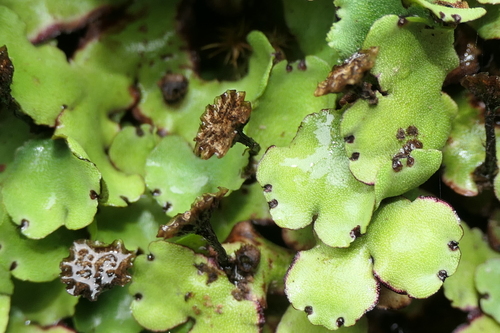
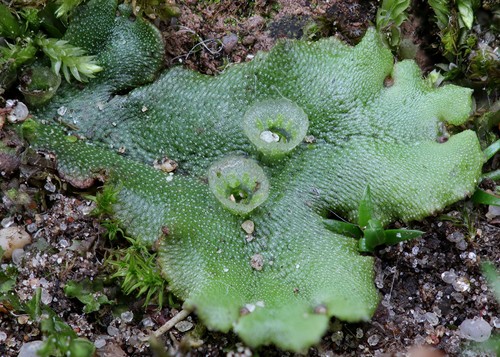
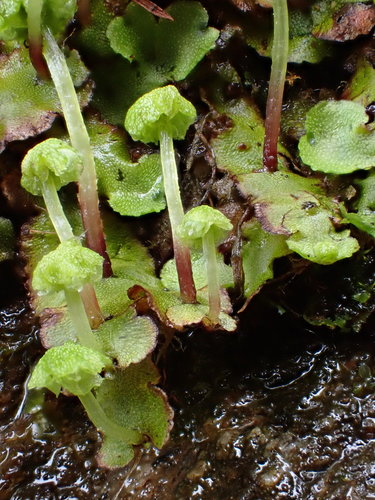
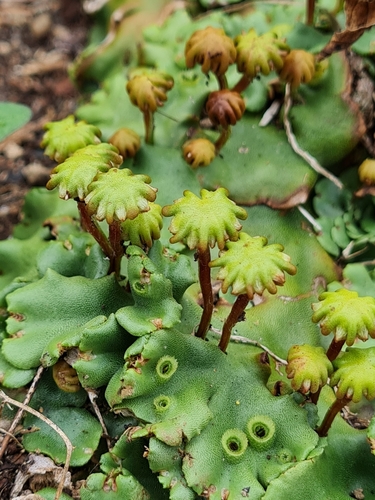
Marchantia berteroana Lehm. & Lindenb. is a flat, thalloid liverwort. Its thallus grows up to 2 cm (0.79 in) long and 1.2 cm (0.47 in) wide, with a color ranging from dark green to yellow and a glossy surface. It attaches to the ground via rhizoids, and pores are visible on its upper surface when viewed under a lens. Gametangia (sex organs) grow vertically from the thallus, and this species is dioicous, meaning individual plants produce either male or female gametangia. Male gametangia are called antheridiophores; they are short, with a flat disc-shaped structure that is approximately 1 cm (0.39 in) wide. Female gametangia are called archegoniophores; they have a taller stem and an umbrella-shaped structure at the top that is approximately 1 cm (0.39 in) wide, which is where the common name of the plant is derived from. This species also reproduces asexually through gemma cups that form on the surface of the thallus. These gemma cups are approximately 4 mm (0.16 in) wide and 3 mm (0.12 in) high, and they appear most commonly in winter when rainfall is higher, because raindrops are required to disperse the gemmules. Marchantia berteroana contains the flavones isoscutellarein and hypolaetin 8-glucuronides. The composition and quantity of these chemicals changes seasonally, depending on the plant's reproductive state: acacetin and its glycosides are absent when gametangia are present. Marchantia berteroana is distributed across Australia, New Zealand, Southern Africa, South America, Antarctica, and non-continental locations including Papua New Guinea, Java, New Caledonia, and various smaller islands. This species prefers moist environments, such as areas near fresh water sources, waterfall splash zones, and forest floors. It is also known to be one of the first colonizing species after bushfires in Tasmanian mixed forests. For additional notes on reproduction, see Marchantia.