About Maratus griseus (Keyserling, 1882)
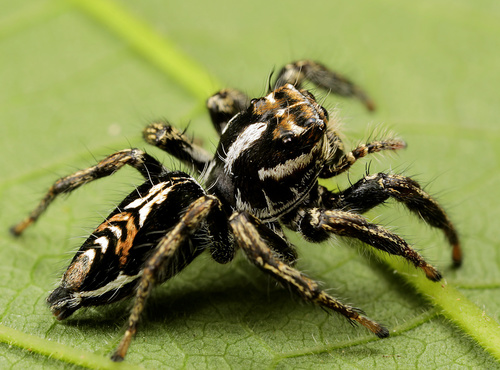
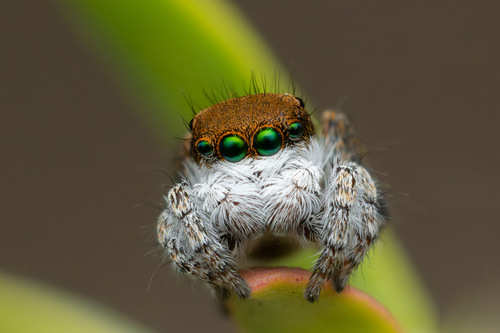
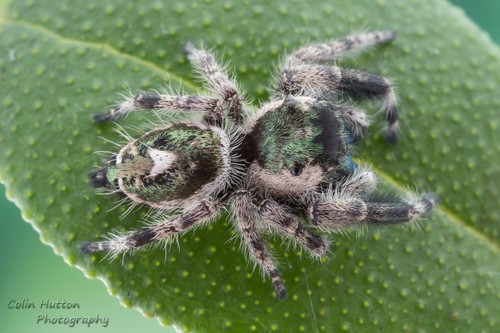
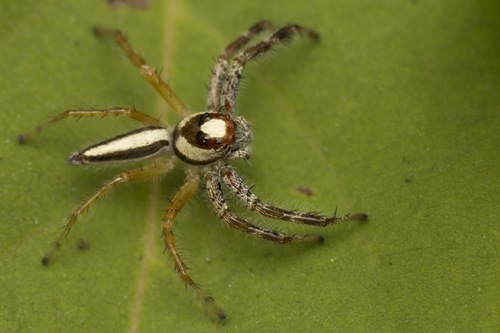
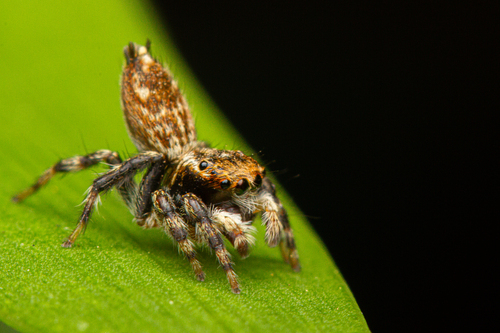
Maratus griseus is a species of peacock spider in the genus Maratus, and can be easily identified by key characteristic features of the species and genus. Adults of this species range from 2 to 6 millimeters in length. They have a rectangular or ovate abdomen, relatively short legs, and chelicerae (fangs) that bear one retromarginal (forward-facing) tooth and two promarginal (backward-facing) teeth. Viewed from above, their rectangular cephalothorax (head) projects above the rest of the carapace. The head holds four pairs of eyes arranged in a straight horizontal row at the top of the head that wraps around the head like a halo, with each pair covering a distinct visual angle. This eye arrangement gives the spider excellent movement-based peripheral vision. The forward-facing pair of eyes are closer-set, more developed, and noticeably larger than the other pairs, which provides the spider with good binocular vision and strong depth perception critical to its hunting strategies. Maratus griseus spiders are generally brown or black overall, with males most often having darker colouration. Males also have a bright reddish-orange band of hairs above and below their eyes, and thick white hairs covering their palps; this distinct colouration is essential to their mating rituals. Females are typically dull brown or black, with only a circular band of white hairs on the head that contrasts with their opaque colouration. This band forms a shape that can look like a circle or "halo" around the head. This species is naturally found in both Australia and New Zealand. In Australia, it typically occurs in temperate regions, including the Australian Capital Territory, New South Wales, Queensland, South Australia, Tasmania, Victoria, and Western Australia. In New Zealand, this species occurs throughout the North Island, and along both the east and west coasts of the South Island; it is more abundant on the South Island's east coast. Maratus griseus is highly adaptable. In New Zealand, it can be found from seashores to mountain areas, while in Australia it occurs in temperate and subtropical forests. It is most commonly found under leaf litter, around leaves, grass, or ferns, and under rocks or logs. It also frequently inhabits human houses, where it can be seen hunting or performing its characteristic mating dances. It can occasionally also be found in warmer, drier climates such as Australian shrublands and dry grasslands. This species is diurnal, mostly solitary, and has a short lifespan of roughly one year. Its life cycle begins around austral Spring (December or January) when spiderlings hatch. Like other salticid species, it is possible that young spiders stay with their mother until shortly after their first moult. Details about the juvenile phase, which typically runs from December/January to the end of July, are limited, and sightings of this species are less common during this period. In August, mature males become more widely sighted, with females emerging shortly afterward. Mating and associated mating rituals take place at this time. As a member of the peacock spider genus Maratus, a group known for elaborate, flamboyant mating rituals, Maratus griseus nevertheless has a unique mating behaviour compared to other members of its genus. The elaborate mating ritual starts when a male spots a female and begins a specific mating dance: the male first stops and faces toward the female, then lifts his third pair of legs to signal her, raises his abdomen perpendicular to his body, and swings it from side to side. Once the female has recognized him, he lowers his legs and approaches her very cautiously with zig-zag movements, slowly attempting to circle the female while closing the distance between them. He remains facing her at all times as he continues swinging his abdomen from side to side. The female may run away at this stage, which can happen several times, but she will allow the male to get closer after each attempt. When the male is close enough (only a few centimeters from the female), he stops swinging his abdomen and lowers it, then stretches out his front legs. Next, he gently taps the female's legs and carapace with his palps, then attempts to climb on top of her to copulate. If the female has already mated, she will reject the male with a specific behaviour that has only been observed in New Zealand populations of this species: the female counters the male's dance by lifting her legs and abdomen in the same way the male does, copies the male's side-to-side abdominal swinging movement, and mirrors him. If this happens, the male stops advancing, and if the female continues this behaviour while approaching the male, he will run away. This behaviour signals to the male that the female is not interested, and that she may become aggressive if he remains. After the mating season ends around December, females retreat to their nests to lay eggs and guard them until they hatch, starting the cycle over again. When two males are near each other during the mating season, they perform a "competing dance". In this display, both males raise their third pairs of legs and their abdomens, but unlike the abdominal side-to-side swinging used to attract females, they keep their abdomens immobile and bent to one side. The third pair of legs stays raised as both males approach each other, which differs from the mating dance, where these legs are lowered as the male closes in on a female. During the competing dance, males use both their abdomens and third pairs of legs as signals while advancing toward each other, and close the distance with zig-zag movements. Once both males have approached and stand in front of each other, they spread their third pairs of legs, their palps, and their fangs, so that each limb touches the tip of the opponent's opposite appendage. When these appendages make contact, one male typically retreats, and the confrontation ends. These spiders are not considered territorial, as observations show that if two males are placed together in an enclosure and complete the competing behaviour described above, both will ignore each other after the interaction and no further aggressive behaviour occurs. However, if one or both males are removed from the enclosure and then placed back into close proximity, the competing dance is repeated, and the same male that retreated the first time will retreat in any later competing dances.