About Marasmius wynneae Berk. & Broome
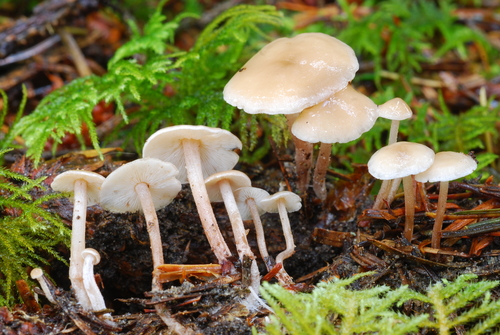
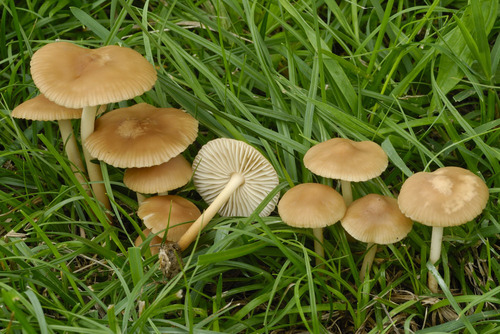
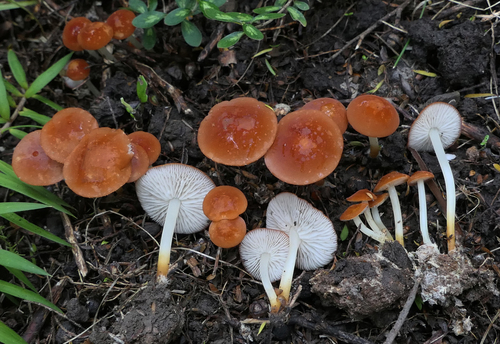
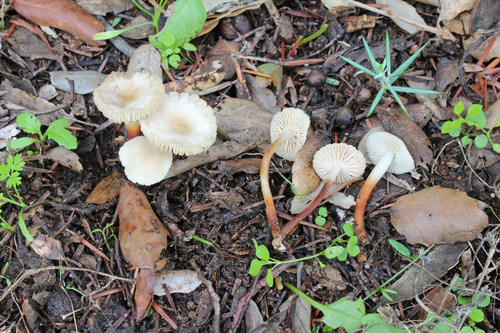
This species has a hygrophanous cap that starts hemispherical and colored white, greyish, or ochre when young. As it matures, the cap expands to become flat, and may turn grey or develop violet tints. Cap diameter ranges from roughly 1 cm to 5 cm. The gills are whitish, thick, and spaced far apart, and are almost free to emarginate. No ring or other veil remnants are present on the fruit body. The stem is tough, reaching a maximum length of around 7 cm and maximum diameter of 0.5 cm. It is whitish when young, and turns red-brown starting from its base. The mushroom has a mild taste. Its odor is initially pleasant, described as similar to hay, melilot, or bitter almonds, but becomes unpleasant after a short time, smelling like acid or a drying facecloth. Spore print is white, and spores are ellipsoid, sometimes elongated with an aspect ratio of up to around 2, measuring approximately 6-8 μm by 3.5-4.5 μm. Club-shaped to spindle-shaped cheilocystidia are present, with lobes at one end. As a saprobic fungus, Marasmius wynneae grows in clusters on humus and leaf litter in beech woods and other broad-leaved woods. Its visible white mycelium can bind leaf litter together into solid sheets. This mushroom is widespread in Europe from August to January, and has been documented in Algeria, Morocco, and Texas, with no confirmed reports from other regions. It is common in western temperate Europe, particularly growing under beech trees.