About Marasmius rotula (Scop.) Fr.
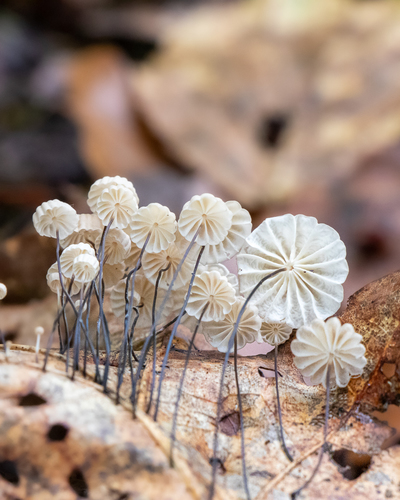
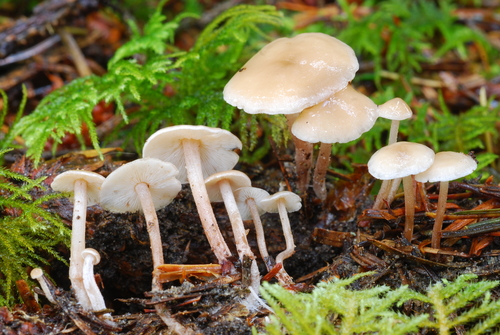
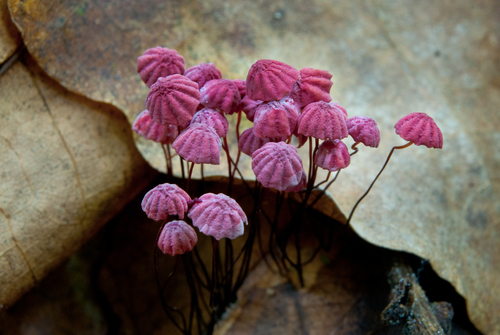
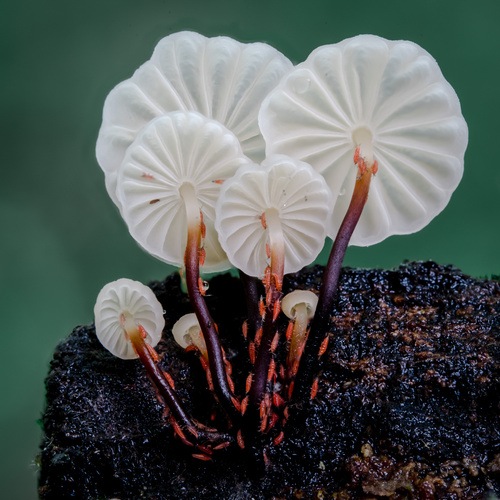
The fruit body of Marasmius rotula has a thin, membranous cap 3 to 20 mm (1⁄8 to 3⁄4 in) in diameter. The cap is convex, slightly depressed in the center, has visible furrows that outline the gills, and scalloped edges. Young, unopened caps are yellowish brown; as the cap expands, its color lightens to whitish or light pinkish-white, often with a darker, sometimes brown center. The variety fusca has brown caps. The white or slightly yellowish flesh is very thin, measuring about 0.25–1.5 mm thick in the central part of the cap, and even thinner at the margin. The gills attach to a collar, never to the stem, though in some specimens the collar is pressed so close to the stem that this feature is less obvious. The gills are widely spaced, match the whitish to pale yellow color of the flesh, and typically number between 16 and 22. They start narrow, and thicken downward to about 1–3 mm at the exposed edge. The stem is 1.2 to 8 cm (1⁄2 to 3 in) long and up to 0.15 cm (0.06 in) thick, with a smooth, sometimes shiny surface. It is tough, hollow, and either straight or slightly curved. It is blackish-brown, fading to a lighter, almost translucent apex. The base of the stem may connect to dark brown or black root-like rhizomorphs 0.1–0.3 mm thick. Mature specimens have no veil. The overall appearance of the fruit body, particularly its color, is somewhat variable and depends on growing conditions: for example, specimens growing on logs in oak and hickory forests in the spring tend to have more yellowish-white, depressed caps, while those found in the same location in autumn are light yellow brown and more convex. Fruit body development in M. rotula is hemiangiocarpous, meaning the hymenium is only partially enclosed by basidiocarp tissues. Robert Kühner demonstrated that a cortina-like tissue covers the young gills before the expanding cap separates from the stem. In unfavorable weather, mushrooms may fail to develop normally, and instead produce semi-gasteroid basidiocarps. When viewed in deposit as a spore print, Marasmius rotula spores appear white or pale yellow. Under an optical microscope, spores are hyaline (translucent), teardrop- or pip-shaped, with dimensions of 7–10 by 3–5 μm. The spore-producing basidia are four-spored, club-shaped or nearly club-shaped, and measure 21–21 by 4–17 μm. Non-reproductive cells called cheilocystidia are interspersed among basidia along the gill edge; these are club-shaped, with rough wart-like projections on their surface. Broom cells are also present on the gill edges; they are variably shaped, thin-walled, and measure 7–32 by 2.5–20 μm. Their apical surfaces are covered with yellowish, blunt, conical warts or incrustations that measure 0.2–1.5 by 0.1–1 μm. Marasmius rotula grows in deciduous forests, producing fruit bodies in groups or clusters on dead wood (especially beech), woody debris such as twigs or sticks, and occasionally on rotting leaves. Its fruit bodies are easy to overlook because of their small size, and are often abundant after rains. The fungus is widespread and common in its preferred habitats across North America, Europe, and northern Asia. While much less common in southerly locations, isolated collections have been reported from Africa (Congo, Nigeria, Sierra Leone, and Tanzania) and South Asia (India). In North America, M. rotula is most common in the eastern part of the continent. Marasmius rotula is a saprobic species, meaning it obtains nutrients by decomposing dead organic matter. The species is relatively intolerant of low water potentials, and will grow poorly or not at all under water stress conditions. It cannot degrade leaf litter until the litter becomes more fragmented and compacted, which increases water-holding capacity in deeper soil layers. The magnolia warbler has been recorded lining its nests with the stems of M. rotula fruit bodies. In 1975, American mycologist Martina S. Gilliam studied spore release periodicity in M. rotula, and found that spore discharge does not follow the regular circadian rhythm typical of agaric and bolete mushrooms. Instead, spore discharge depends on rain: a threshold amount of rainfall is required to trigger spore discharge, and the duration of peak spore discharge correlates with the amount of rainfall, rather than how long the rain lasts. Gilliam also noted that spore prints were easier to obtain when stem ends were placed in water, which suggests water must enter the fruit body for discharge to occur. Like fruit bodies of many other Marasmius species, M. rotula fruit bodies can desiccate and shrivel during dry periods, then revive when sufficient moisture becomes available again from rain or high humidity. Gilliam's study showed that revived fruit bodies can discharge spores for at least three weeks. In comparison, previous similar studies of other Agaricomycetes found spore discharge lasted only up to six days after revival. The potential for sustained spore production and discharge may come from the growth of new basidioles (immature basidia) during growth periods, which complete maturation when the mushroom revives. This may also explain why gills become thicker as the mushroom matures. Marasmius rotula is generally considered inedible, but is not poisonous. It has no distinguishable odor, and its flavor ranges from bland to bitter. In the 1920s, Louis Krieger wrote in National Geographic that the mushroom was added to gravies, and when used to garnish venison it "adds the appropriate touch of the wild woodlands". The fruit bodies bioaccumulate cadmium: a study of metal concentration in 15 wild mushroom species from India found that M. rotula accumulated the highest cadmium concentration of the species studied. A peroxidase enzyme called MroAPO (Marasmius rotula aromatic peroxygenase) is the focus of research for potential applications in biocatalysis. In general, enzymes that catalyze oxygen-transfer reactions are very useful for chemical synthesis, because they work selectively and under ambient conditions. Fungal peroxidases can catalyze oxidations that are difficult for organic chemists to achieve, including oxidations of aromatic substrates such as aniline, 4-aminophenol, hydroquinone, resorcinol, catechol, and paracetamol. The M. rotula enzyme is the first fungal peroxygenase that can be produced in high yields. It is highly stable across a wide pH range, and in a variety of organic solvents. The enzyme also has potential use as a biosensor for aromatic substances in environmental analysis and drug monitoring.