About Marasmius oreades (Bolton) Fr.
Scientific name: Marasmius oreades (Bolton) Fr.
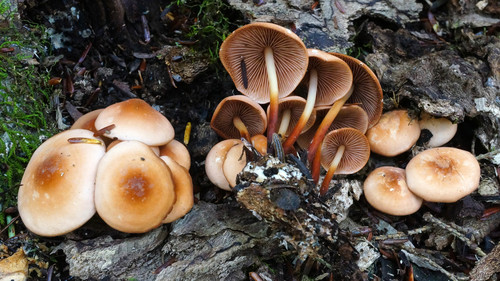
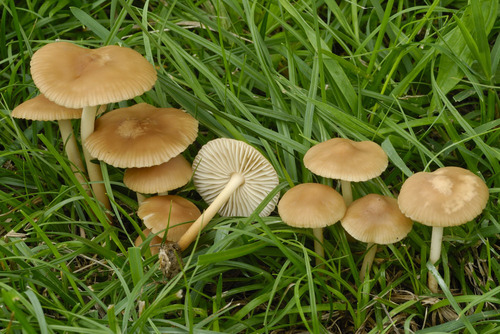
Description The cap measures 1–5 centimetres (1⁄2–2 inches) across. It is bell-shaped with a somewhat inrolled margin when young, later becoming broadly convex with an even or uplifted margin. It usually retains a slight central bump, and has a dry, smooth surface. Cap color ranges from pale tan or buff (occasionally white) to reddish tan; it usually changes color markedly as it dries out, and the margin is sometimes faintly lined. The bare, pallid, tough stem grows up to about 2–6 cm (1–2+1⁄2 in) tall and 2–6 mm (1⁄16–1⁄4 in) in diameter. The gills are either attached to the stem or free from it. They are fairly thick, spaced apart, and white or pale tan. The fungus has a cyanide-like odor, and produces a white spore print. The spores measure 7–10 μm × 4–6 μm; they are smooth, elliptical, and inamyloid. Cystidia are absent, and the pileipellis lacks broom cells.
Distribution and habitat Marasmius oreades grows extensively across North America (it is more diverse and common in eastern North America) and Europe. It fruits in summer and autumn (May–November in the UK), and may fruit year-round in warmer climates. It grows in grassy areas including lawns, meadows, and even coastal dunes. It grows gregariously in troops, arcs, or fairy rings (type II rings, which cause the grass in the ring to grow thicker and greener).